Inpage Navigation Section: Overview
Colour
Inpage Navigation Section: Gallery
Inpage Navigation Section: Features & Specs
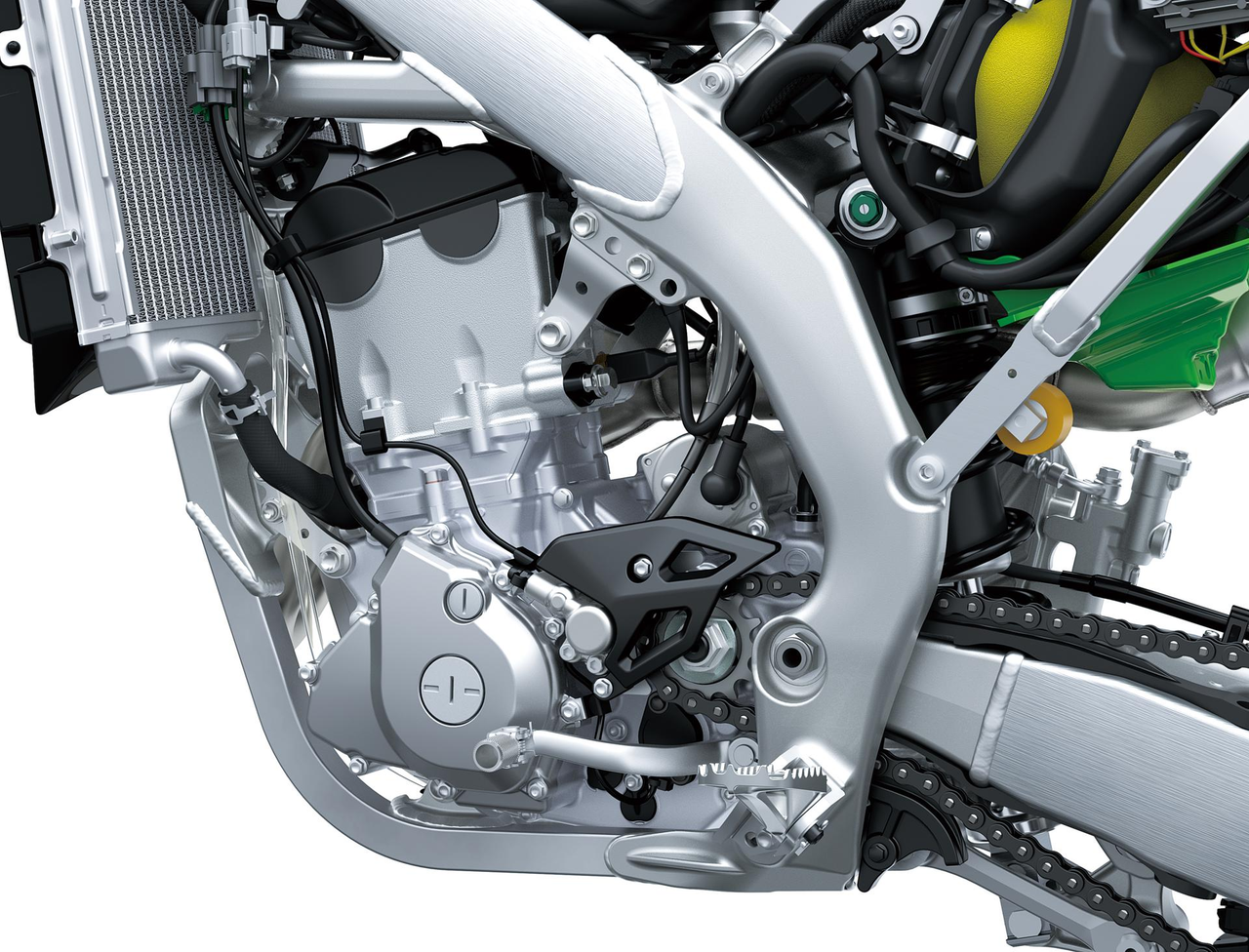
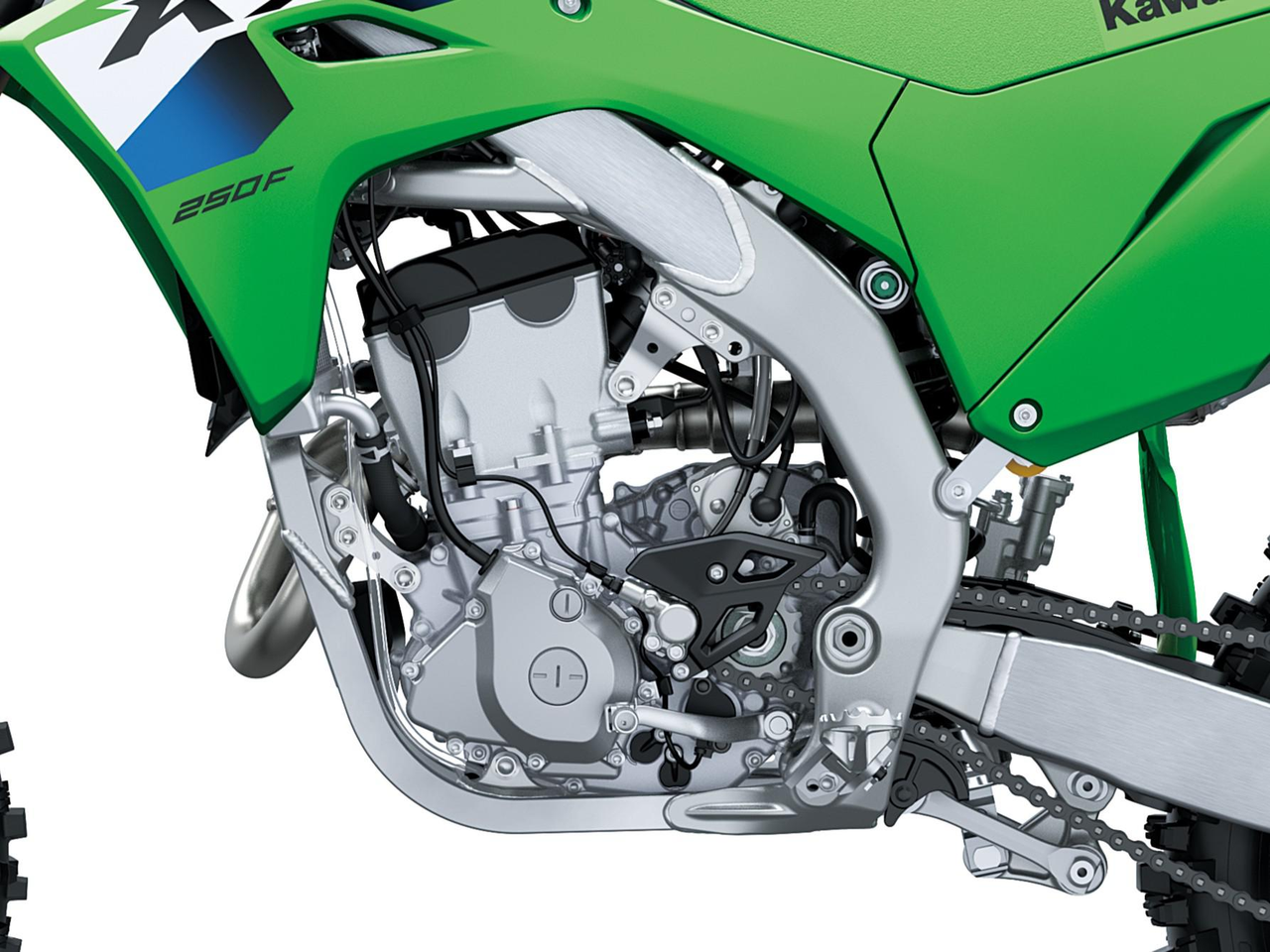
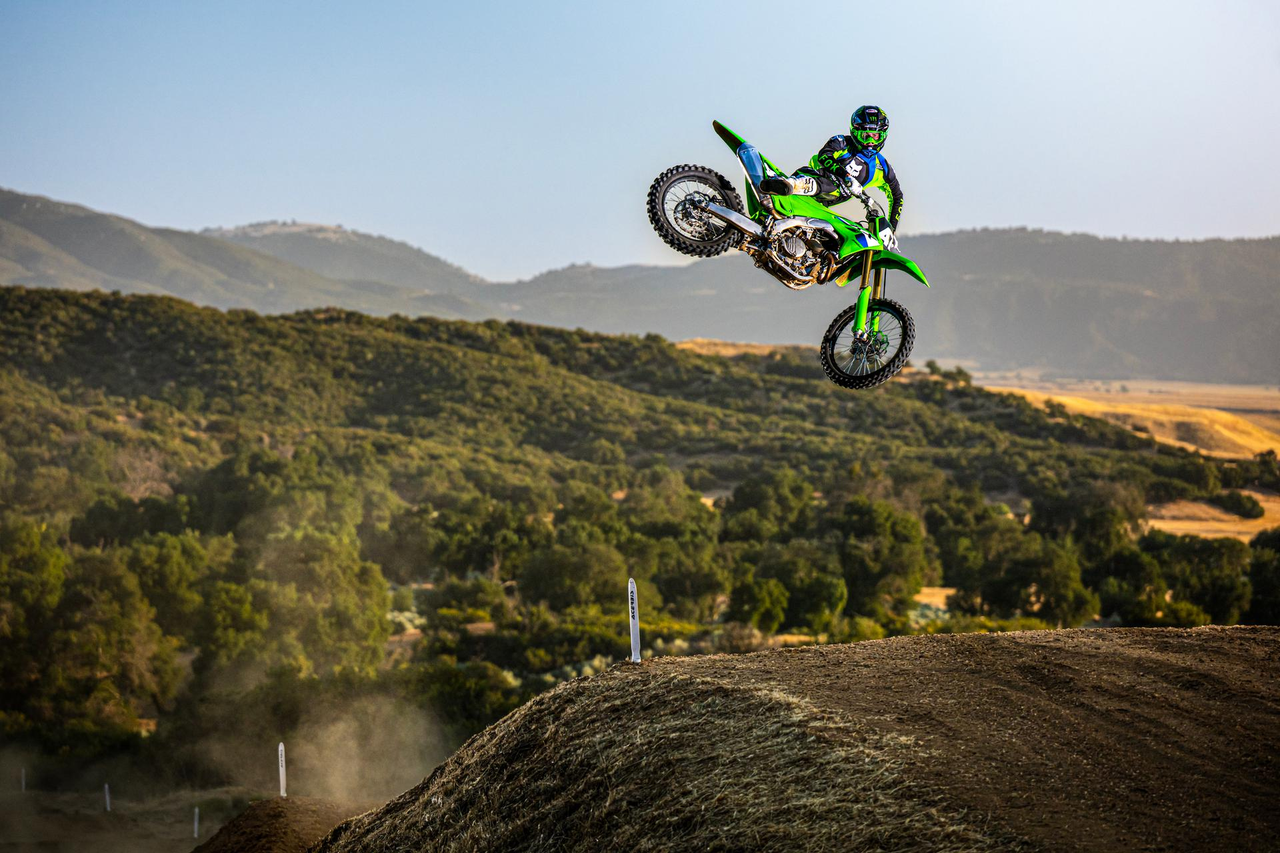
The KX250F engine retains the elements that made it such a strong performer: finger-follower valve actuation, intake and exhaust layout optimised for efficient flow, dual injectors, and a single-shaft primary balancer—elements that together deliver strong, controllable power. Further refinements for 2027 result in increased output, more linear throttle response, and more efficient power transfer, contributing to an overall boost in race-ready performance on the track.
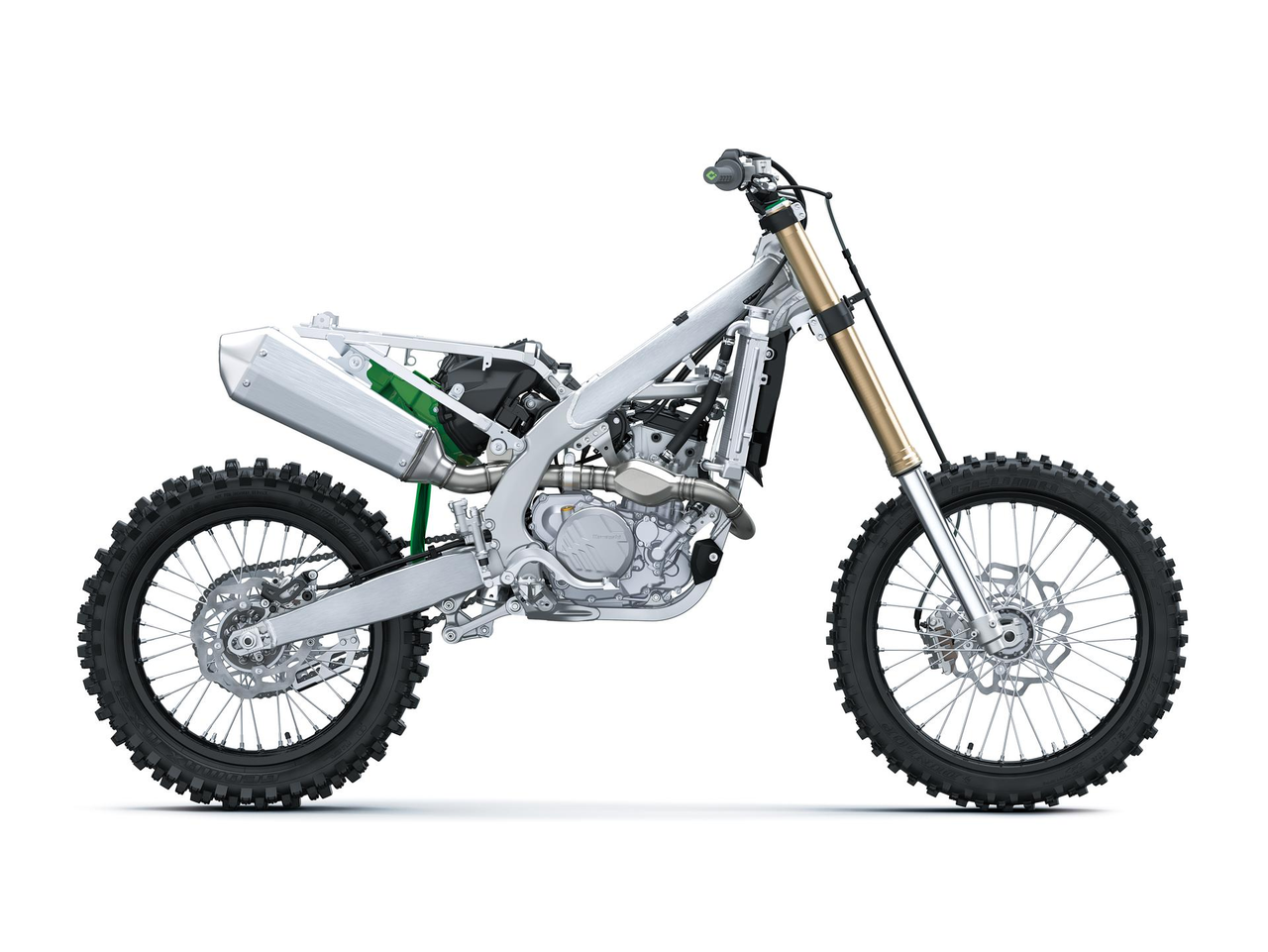
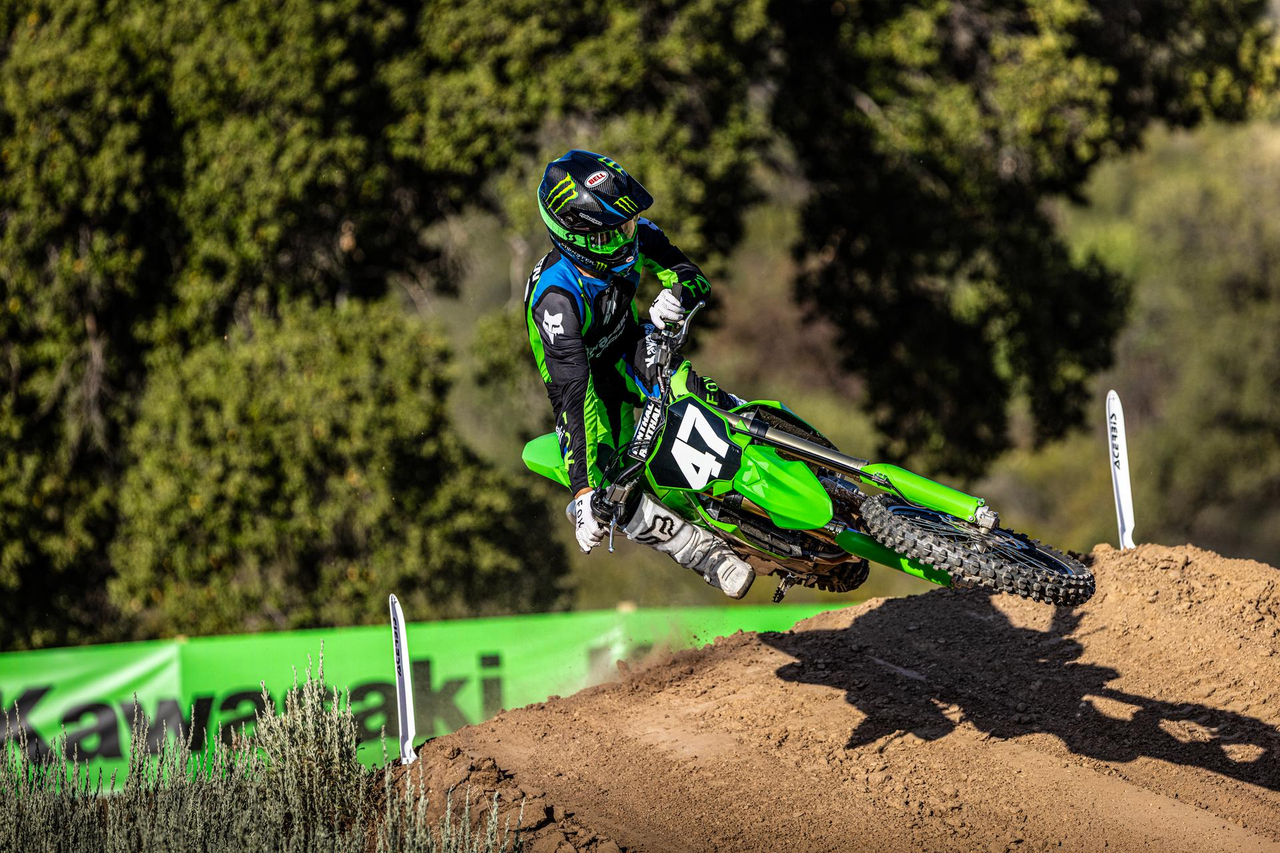
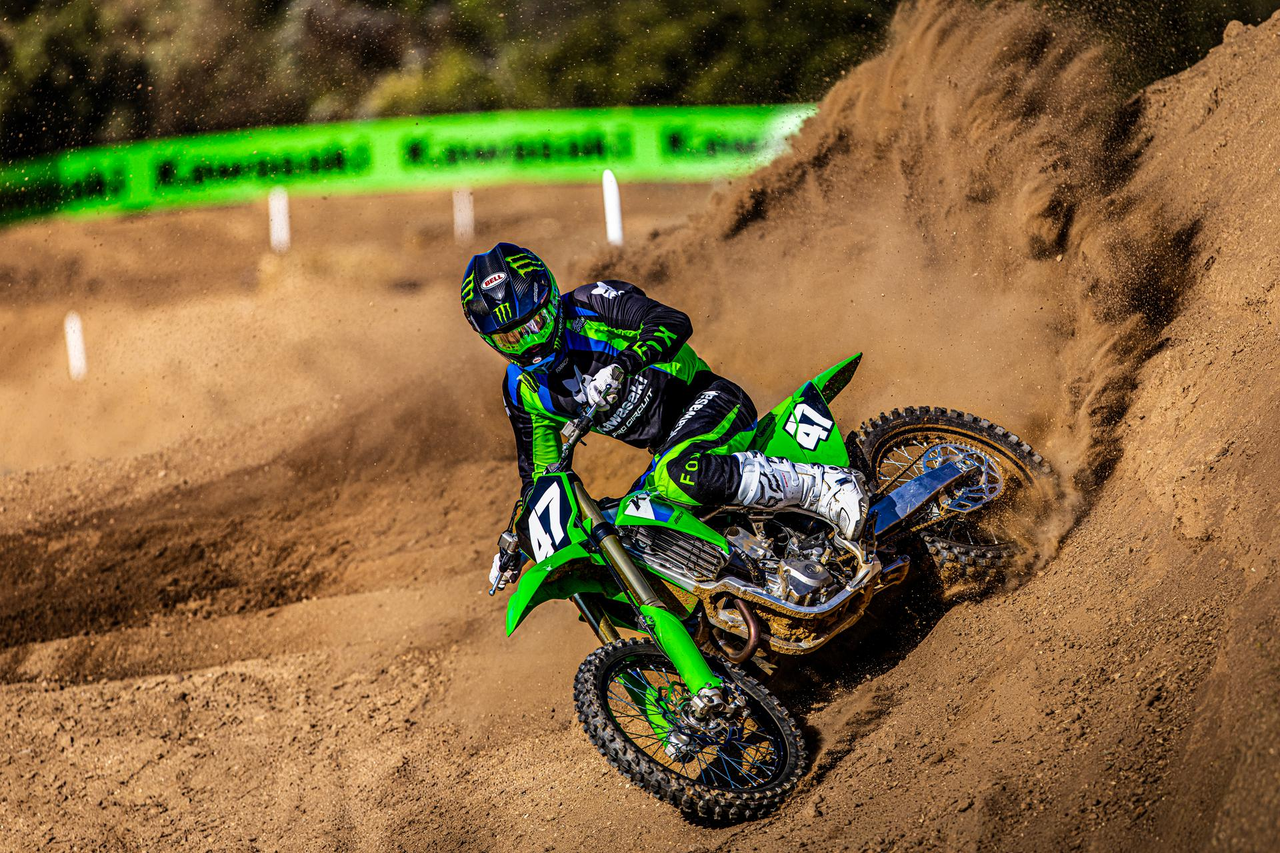
While retaining the previous model’s light, agile handling character, the KX250F motocrosser//KX250FX cross-country racer receives chassis updates that add to its composed behaviour. Central to these updates are revised front and rear suspension settings, which offer increased ground-holding performance, particularly on challenging surfaces. A more compact silencer, used on non-North American models, contributes to reduced weight and mass centralisation, offering chassis characteristics that allow riders to make full use of the improved power feeling.
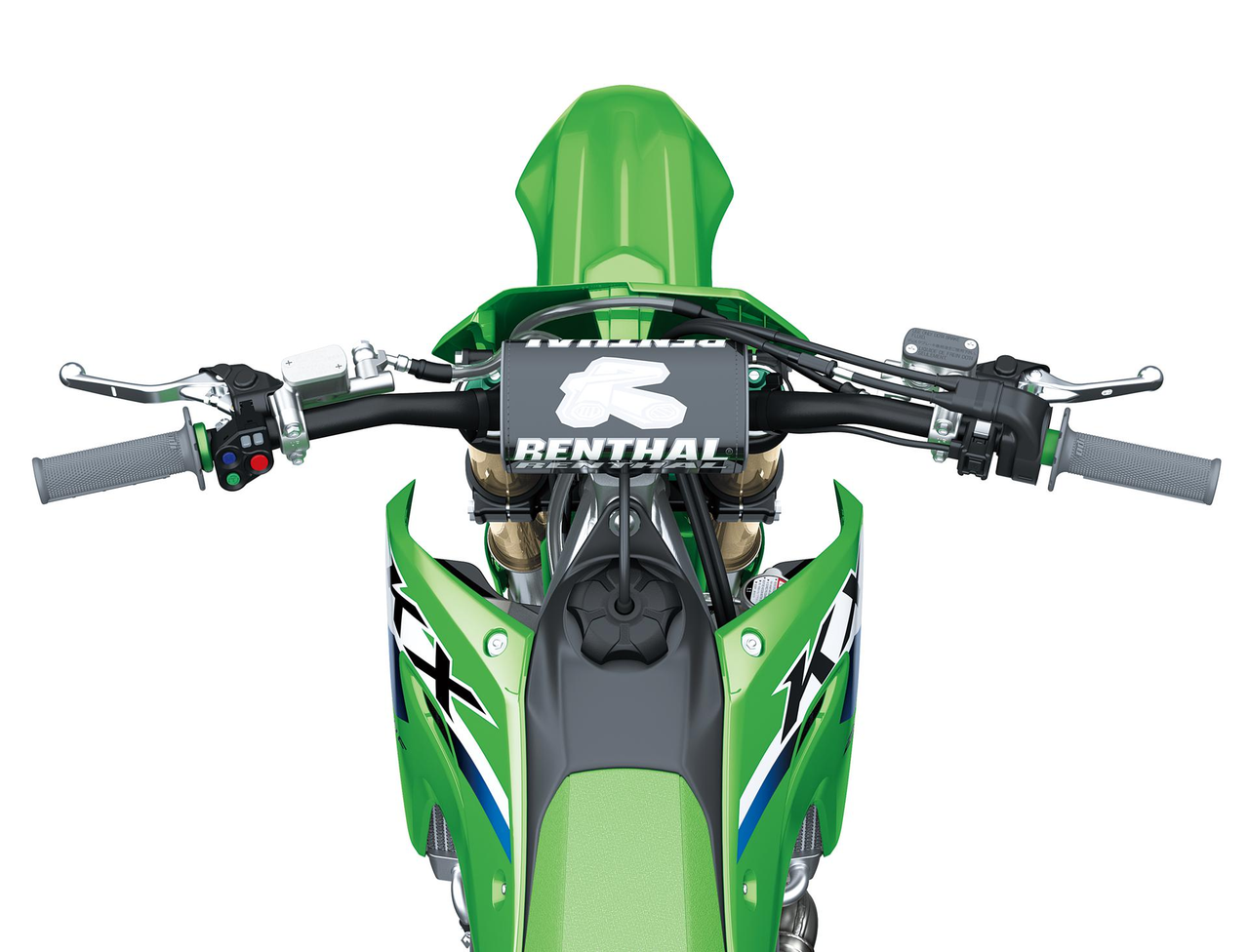
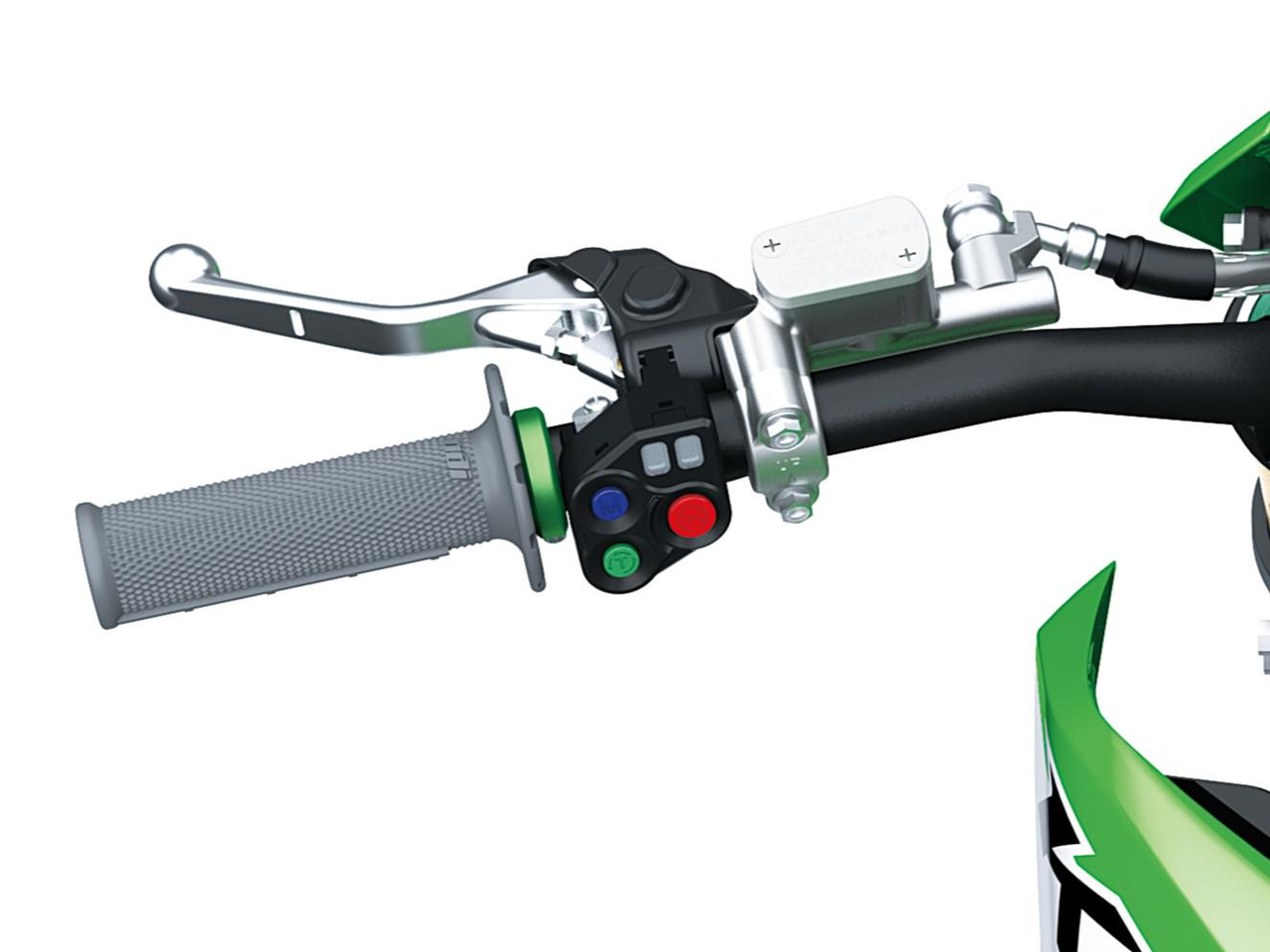
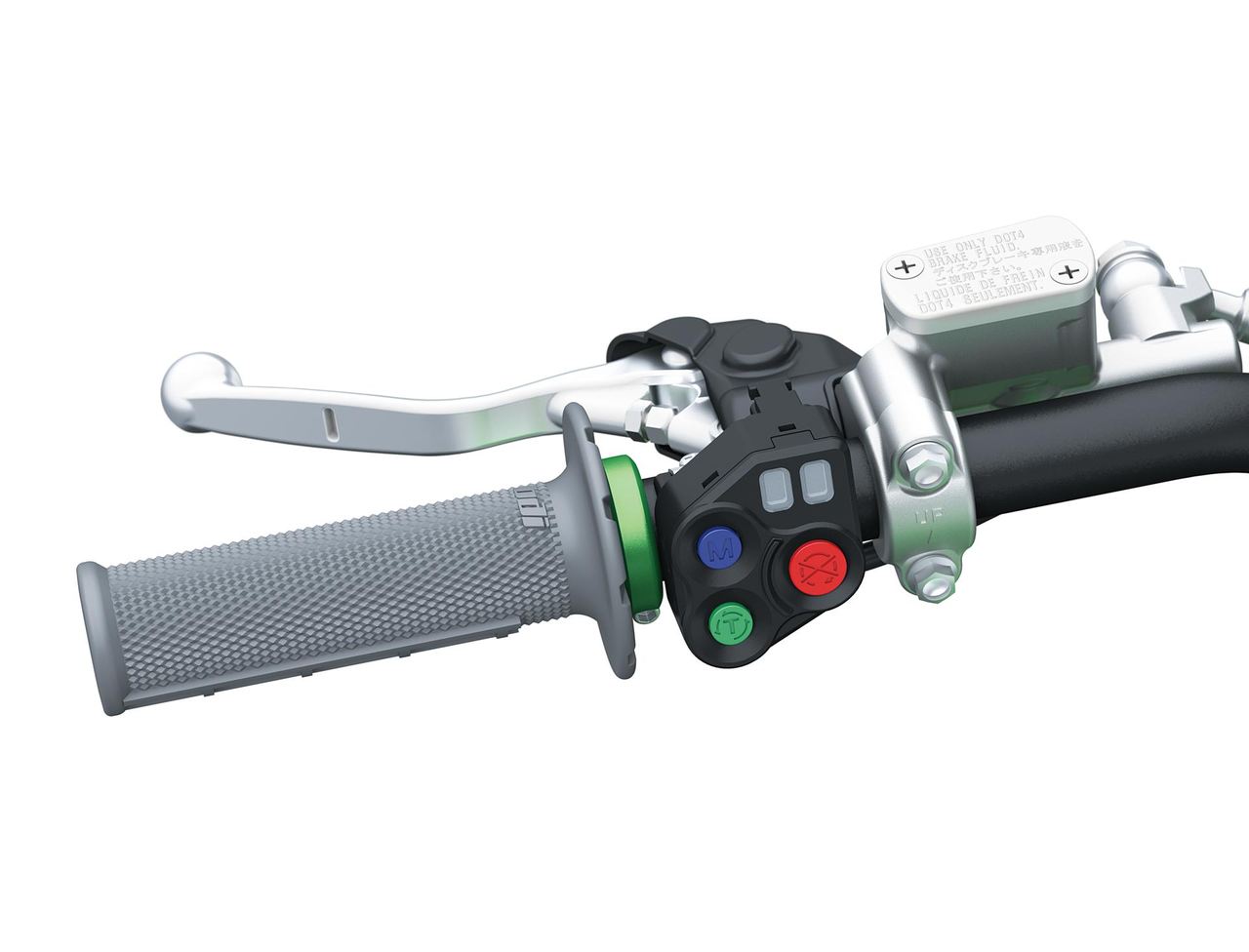
Power Mode selection, Kawasaki TRaction Control and Launch Control Mode are all accessible from the left handle switches at the push of a button. And with smartphone connectivity, riders can adjust engine maps right from their smartphones.
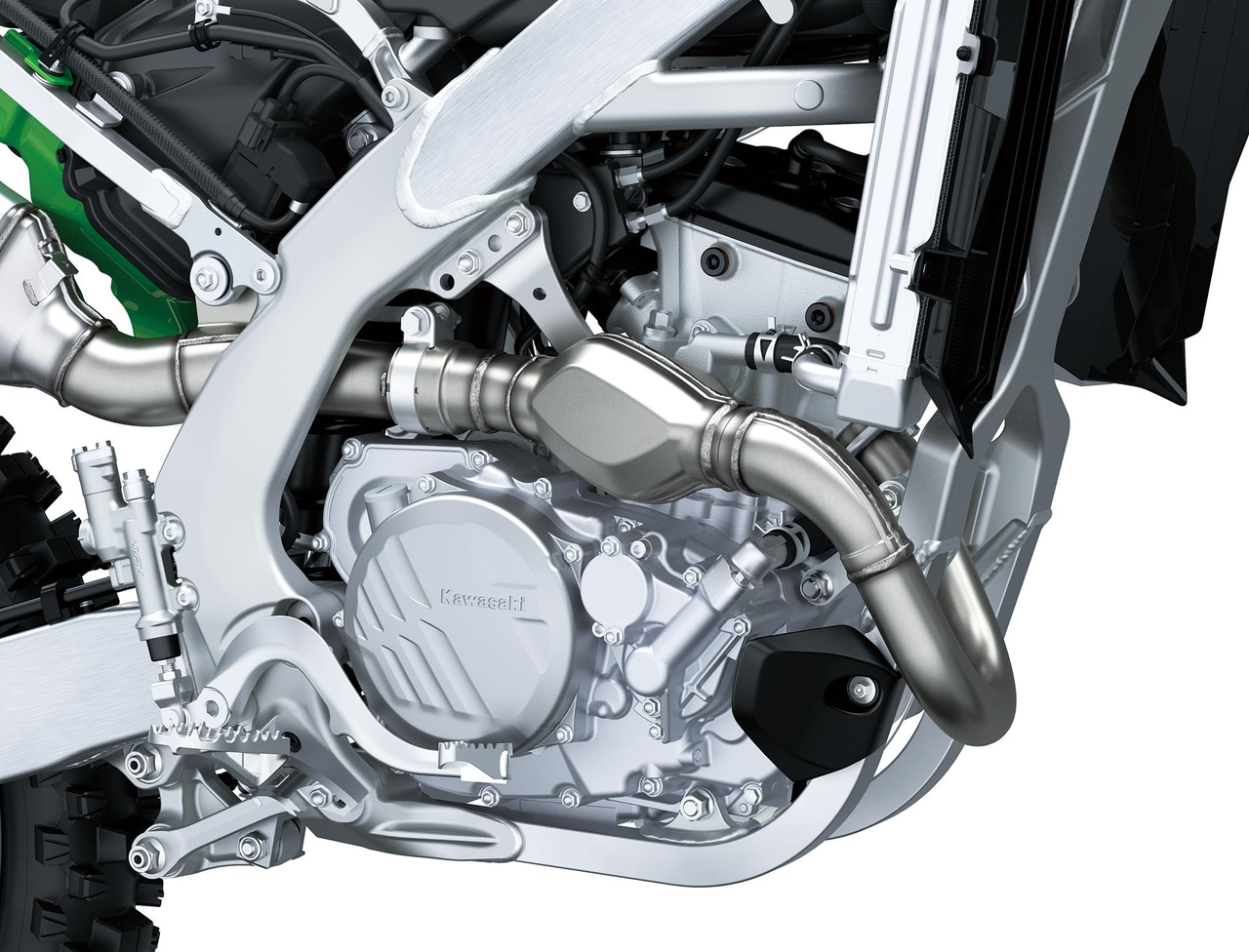
Even when a machine produces strong power, that power must be delivered in a way that riders can fully control if it is to translate into quick lap times. With this philosophy, the KX250F motocrosser pursues an engine character that is truly “fast” on the track. Revisions to the combustion chamber shape improves combustion efficiency and increases peak power, while an extended exhaust pipe and updated internal structure for the silencer contribute to stronger low-end torque, delivering increased power throughout the rpm range. Updated FI settings add linearity to improve power delivery.
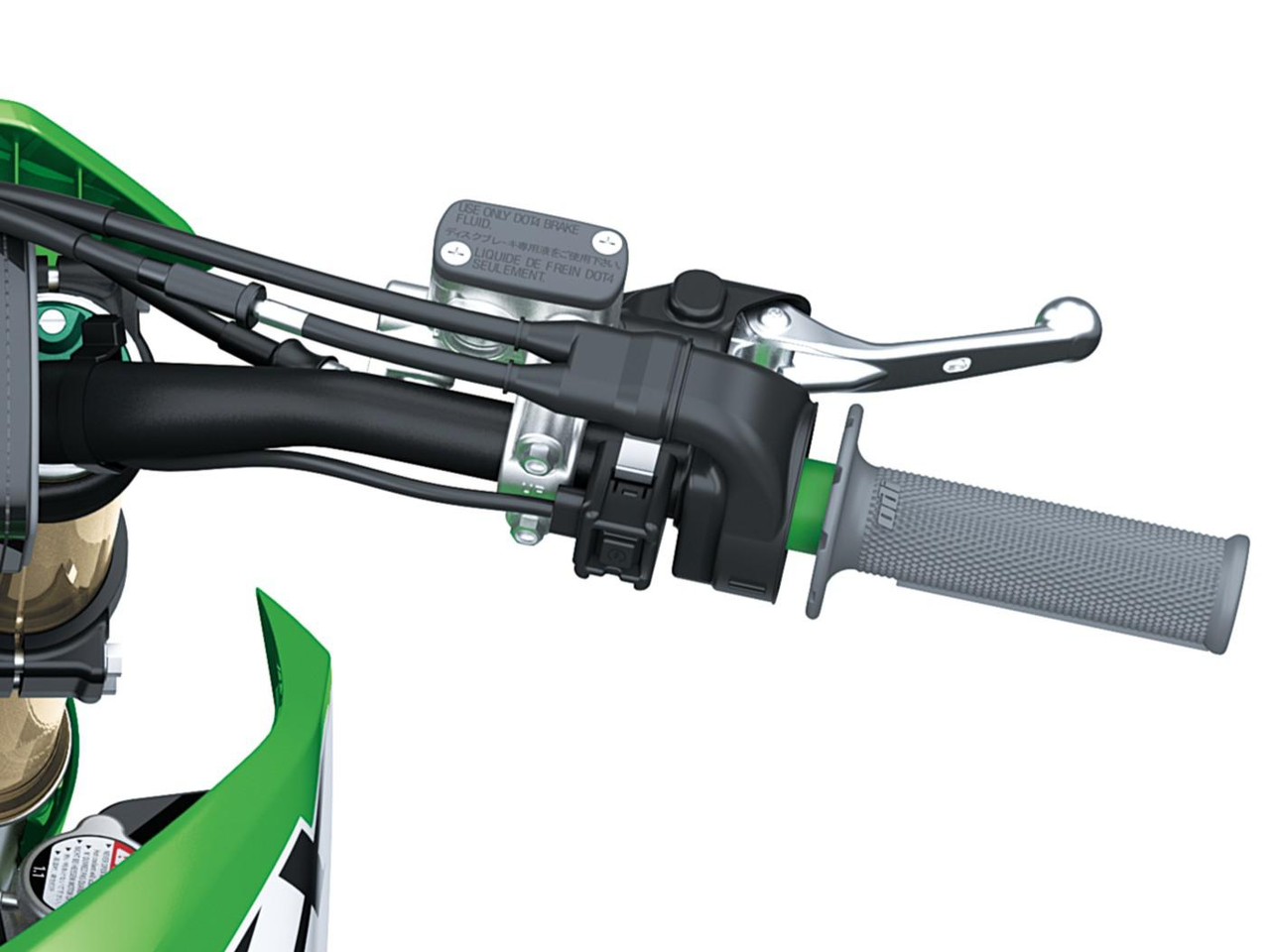
Compared to a conventional clutch, the hydraulic clutch offers more direct feel and lighter lever action. Less play as the clutch heats up during heavy use results in more consistent feeling. Improved for 2027, the clutch spring load has been increased by 15%. This helps suppress clutch slip and allows the engine’s stronger output to be transferred more directly to the rear wheel, giving the rider a more forceful, forward-driving feeling.
Symmetrically aligned intake and exhaust contribute to a strong over-run and smooth low-rpm torque characteristics. The intake offers a straight route for air-fuel mix to enter the cylinder, while the centrally positioned exhaust port lines up with the intake for high airflow efficiency—both contributing to performance. The optimised downdraft intake also adds to low-end performance.
A single-shaft primary engine balancer contributes to smoother power delivery and reduced vibration, which improves control, especially when exiting slower-speed corners.
Being able to restart an engine quickly during a race can mean the difference between keeping your lead or having to fight your way back through the pack. Electric start makes restarting the engine as easy as pushing a button.
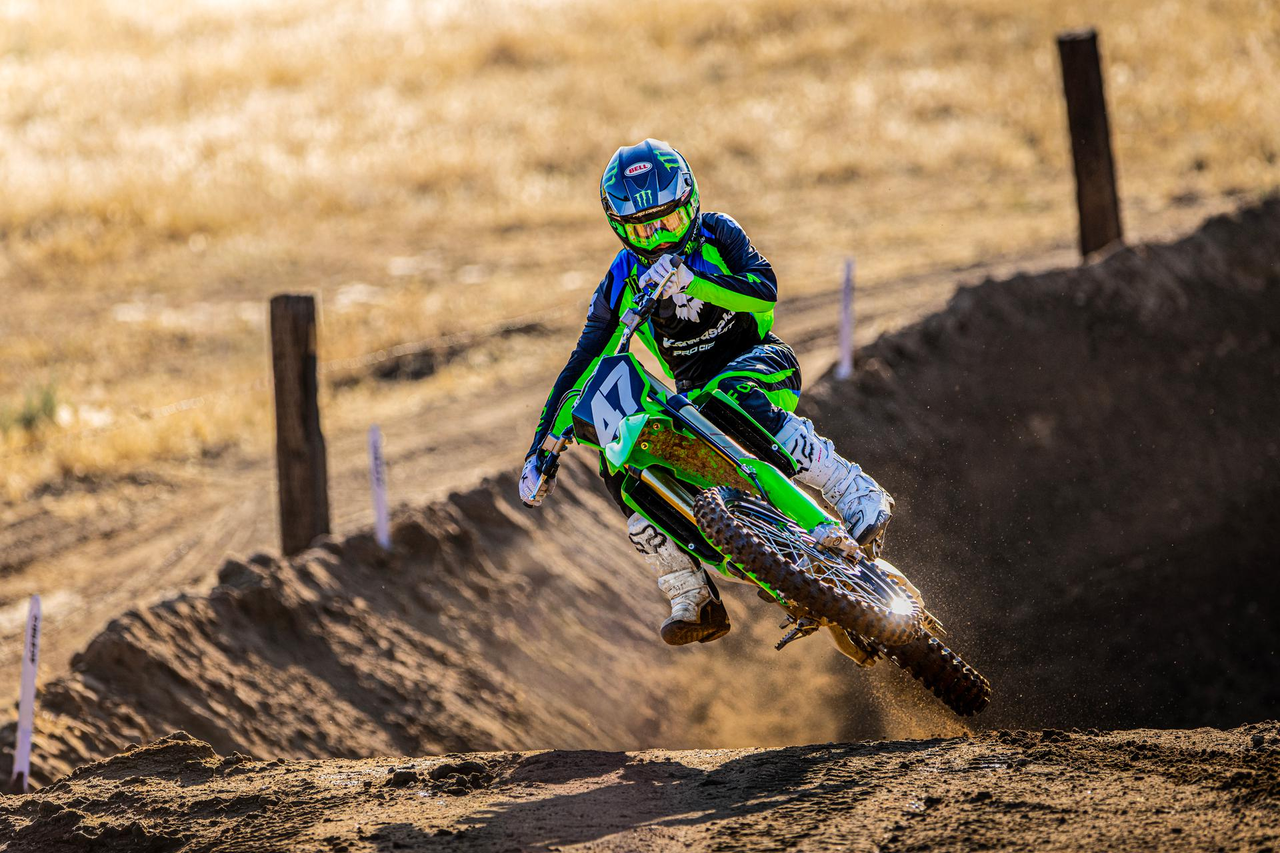
The frame delivers both light, nimble handling and a composed character. Its optimised rigidity balance offers the front-end feel that helps riders when cornering, across a wide range of conditions.
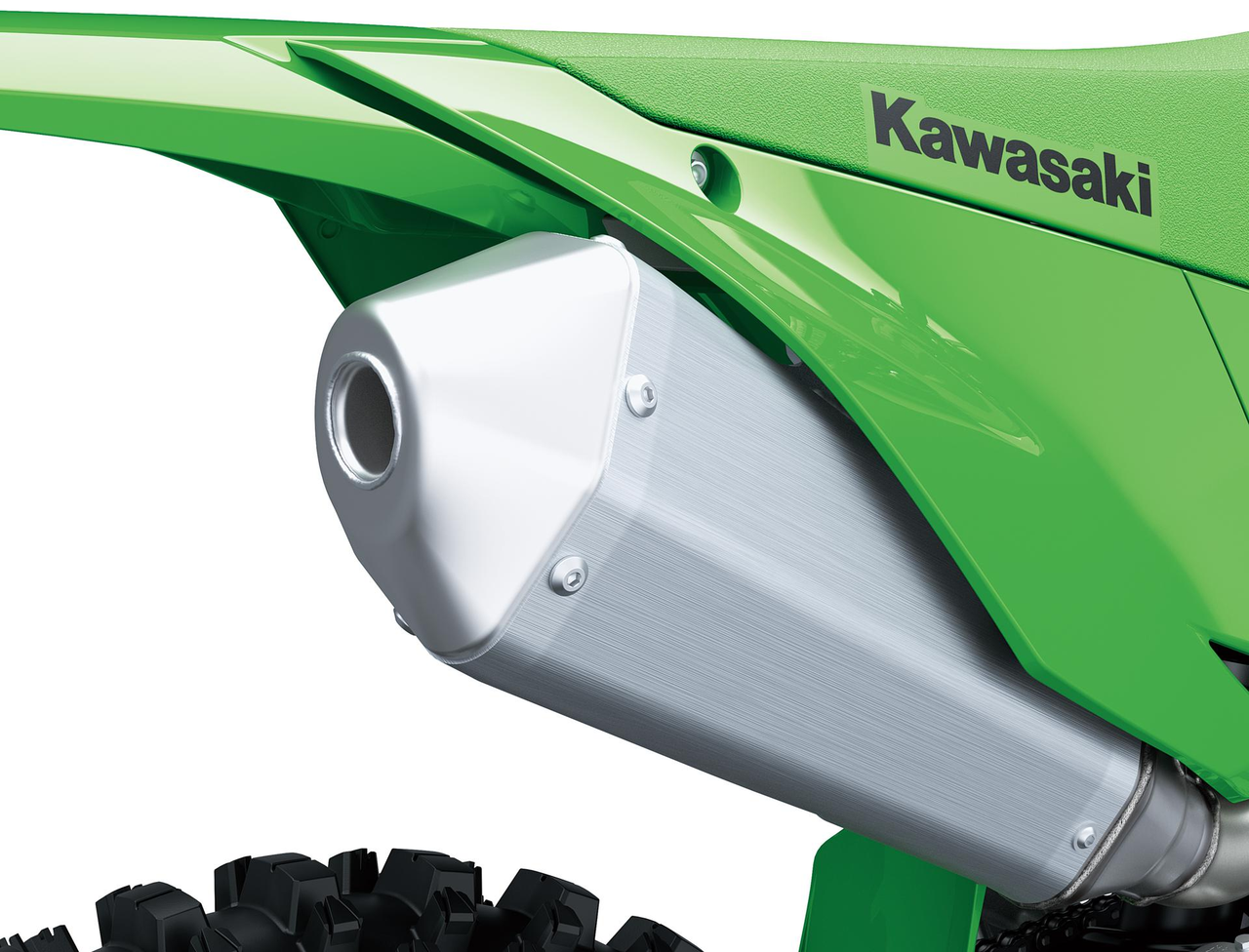
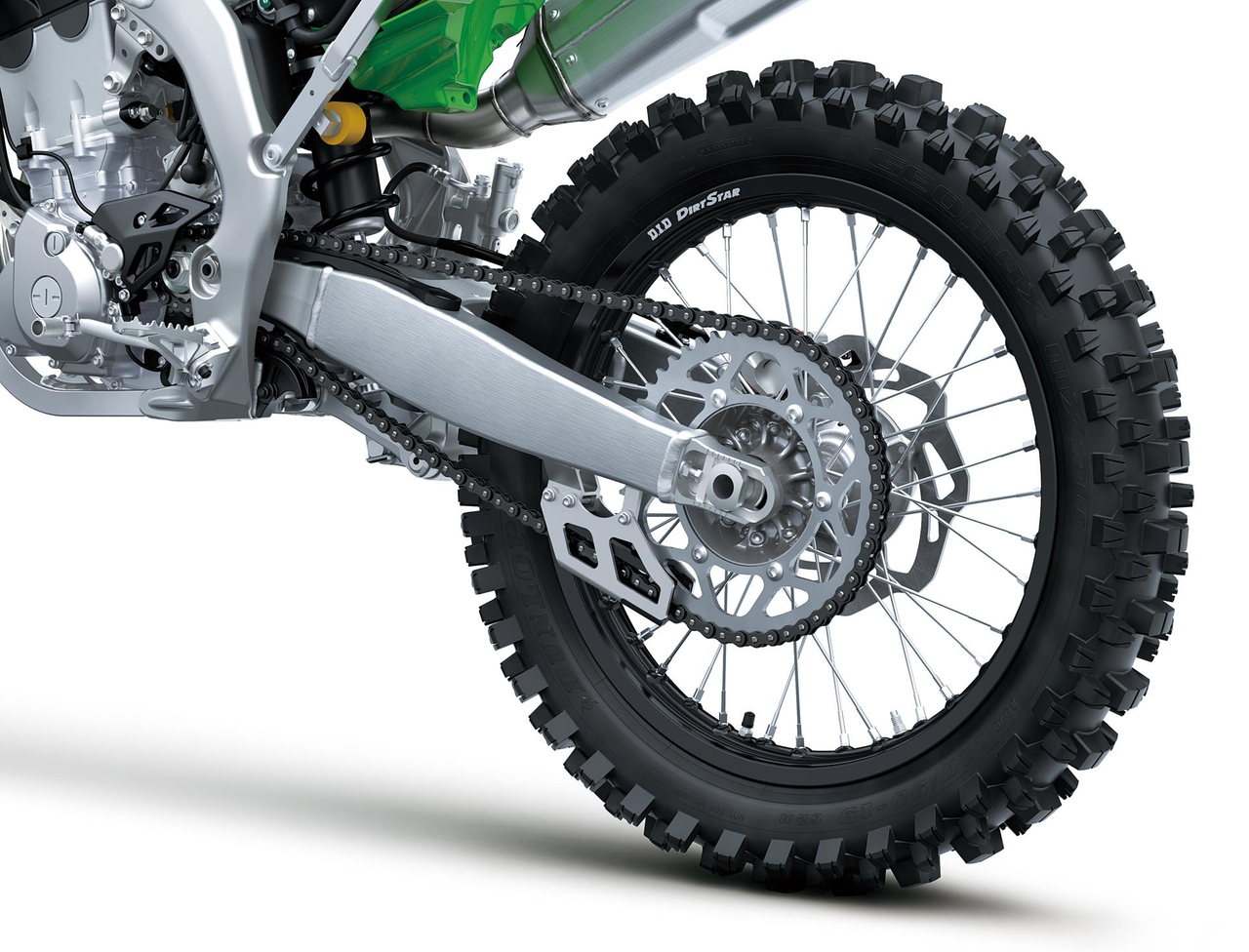
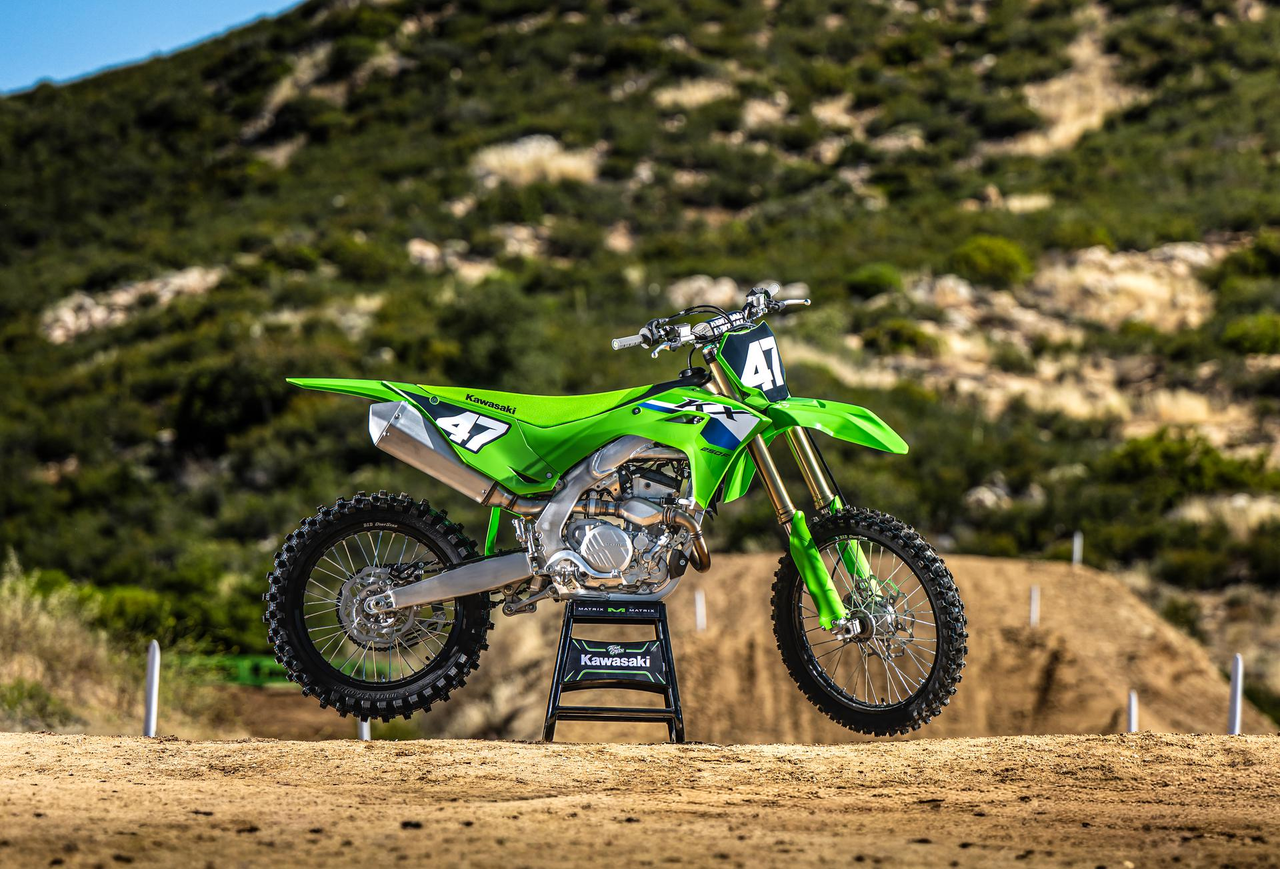
A new short-type silencer is featured on the KX250F. The new unit is 50 mm shorter and 230 g lighter, contributing to mass centralisation and a lighter, more responsive handling character.
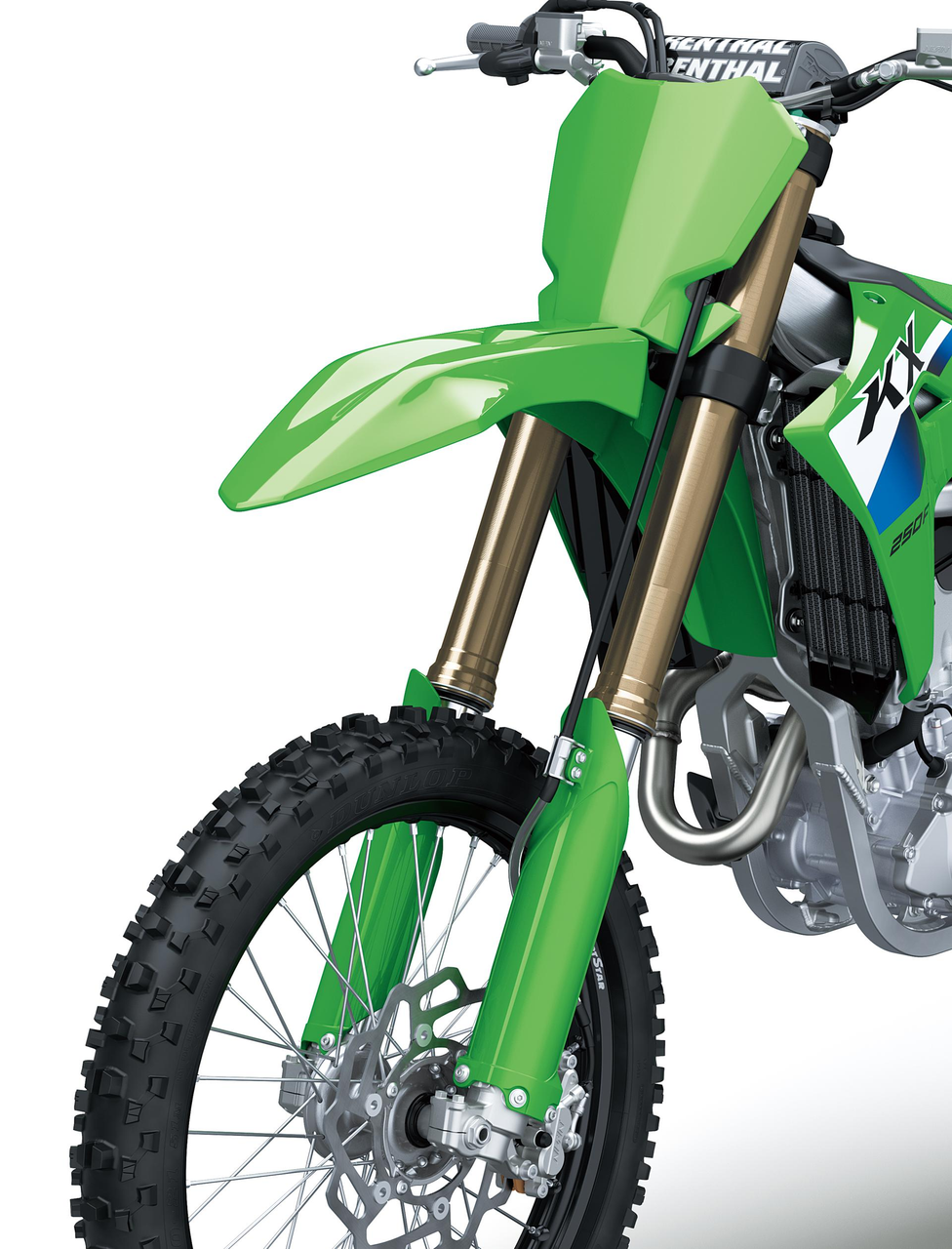
High-performance Showa Ø 49 mm inverted coil-spring fork and New Uni Trak rear suspension offer race-ready suspension performance and adjustability to let riders tune their settings to suit conditions. Revised suspension settings front and rear offer increased ground-holding performance. The updated settings provide more confident performance on challenging surfaces and make it easier to respond to track conditions that change from lap to lap. Spring rates and damping settings optimised for the cross-country scene offer increased feedback, especially when riding on challenging trails.
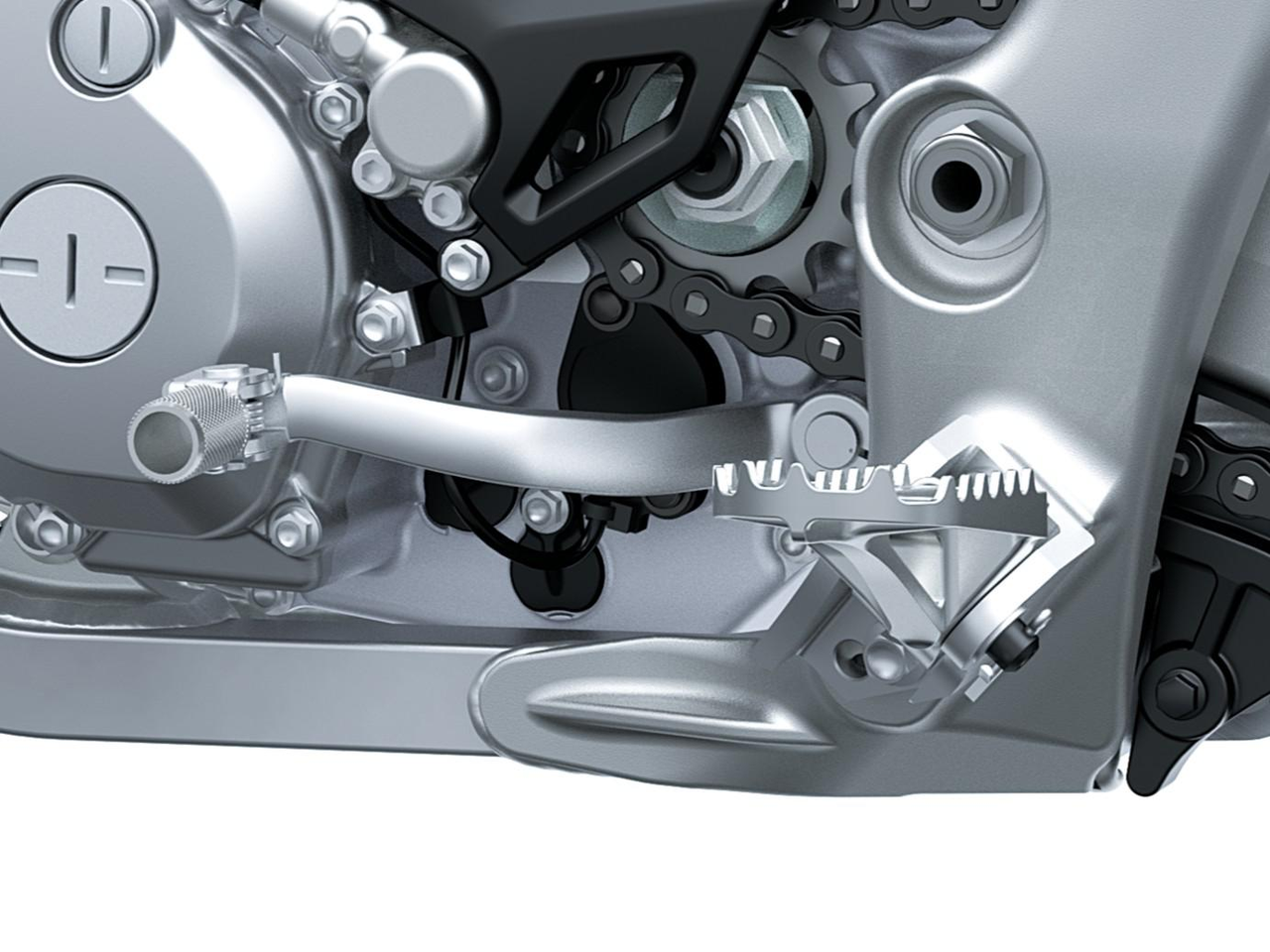
Complementing the KX250F’s slim ergonomics, the shrouds, side covers and rear fender feature smooth surfaces that eliminate hooking points, making it easier for the rider to slide back and forth. A choice of four handlebar positions (25 mm forward, 15 mm forward, standard and 10 mm back) and two footpeg positions (standard, 5 mm lower) allows riders to tailor their riding position to suit body size and preference. Factory-style Ø28.6 mm (1-1/8”) Renthal aluminium Fatbar helps reduce vibration and shocks transmitted to the rider.
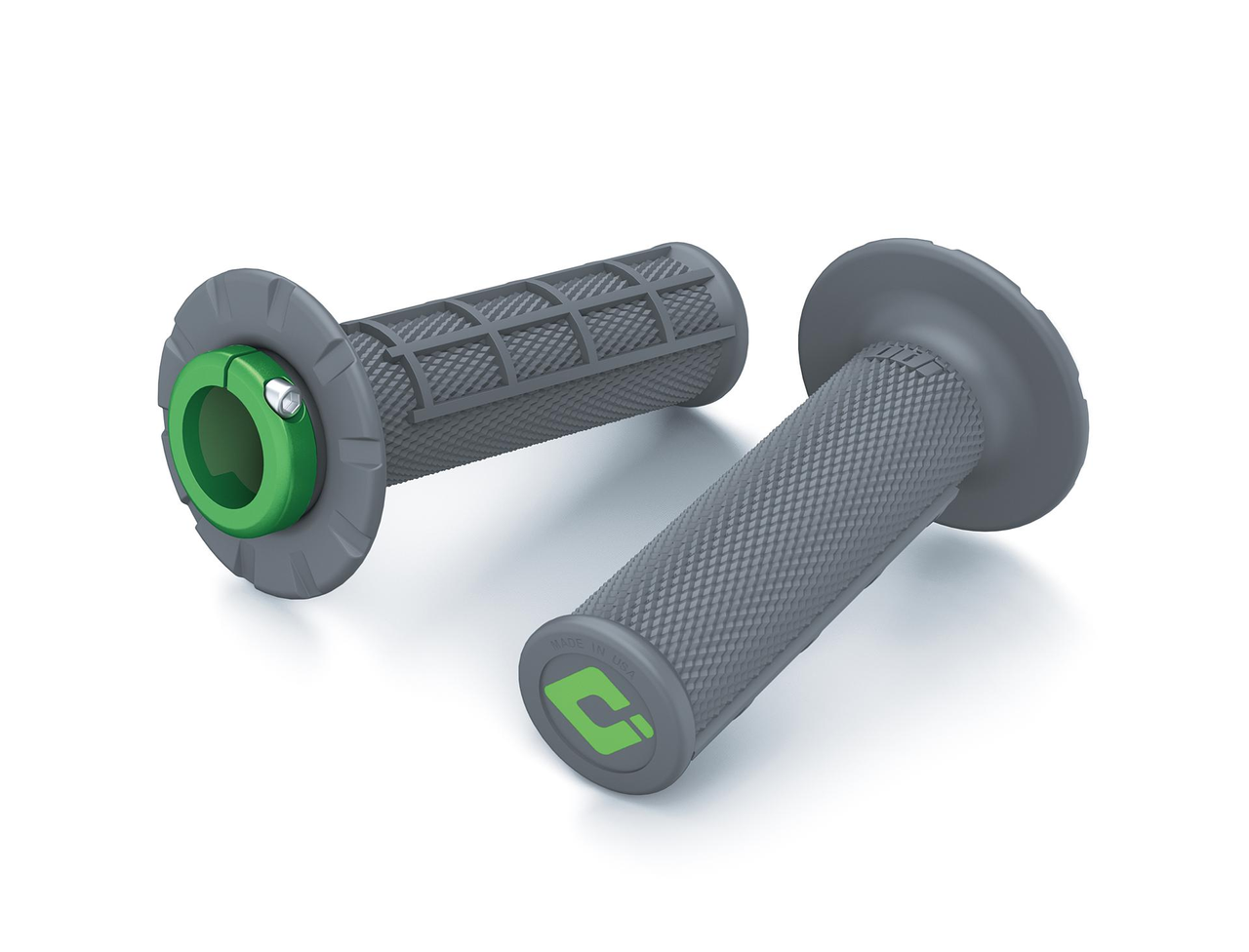
Medium-compound ODI Lock-On Grips offer excellent grip feel, while their screw-type fastening system greatly facilitates the task of swapping grips.
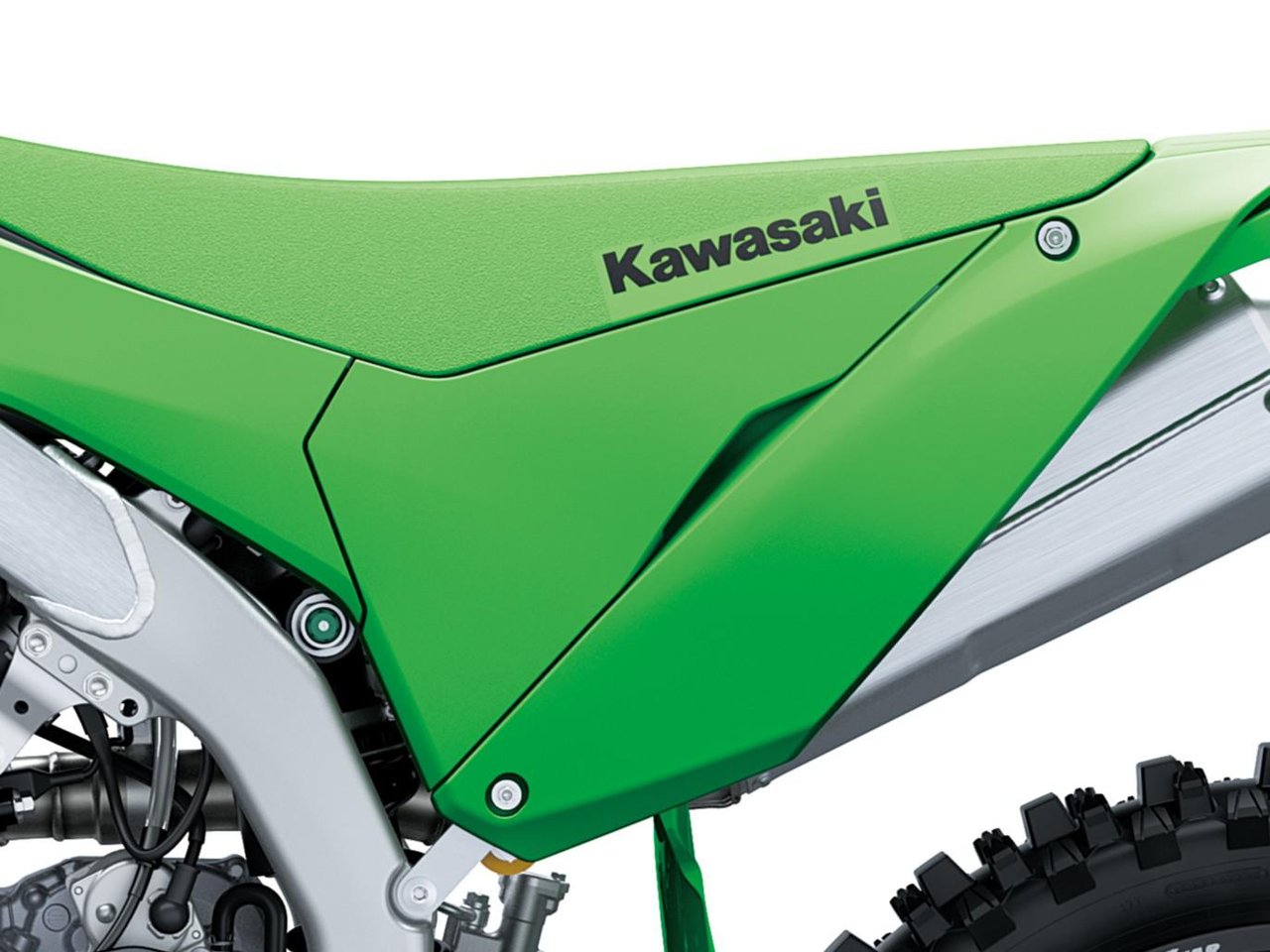
Left side cover can be removed without tools, facilitating access to the air filter element. The element is now secured with quick-release hooks (previously a wing bolt), which makes changing the air filter a much simpler task—something that enduro or cross-country racers will especially appreciate.
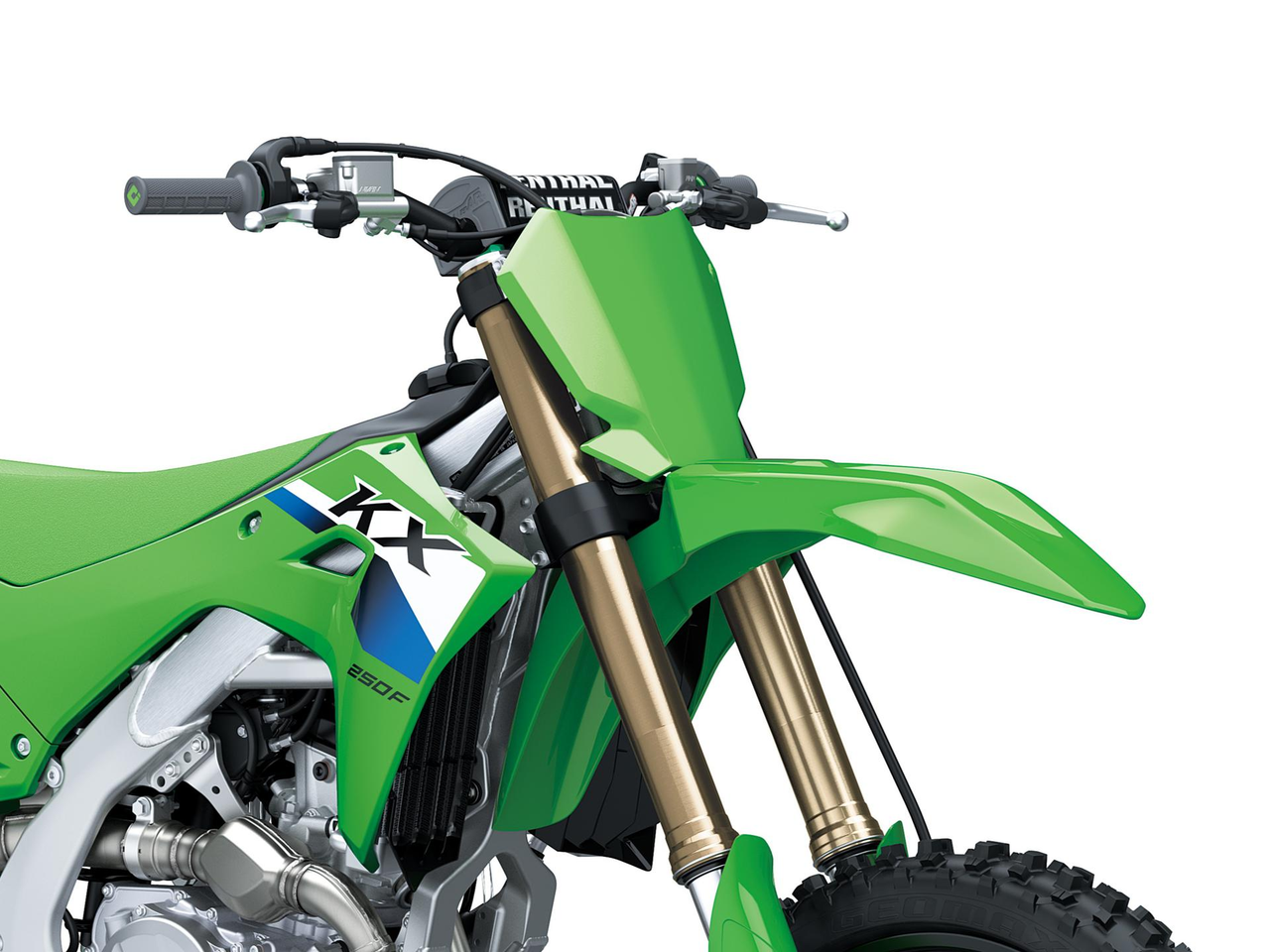
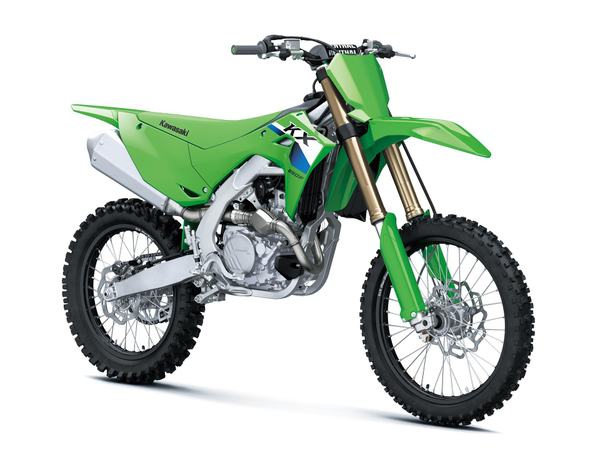
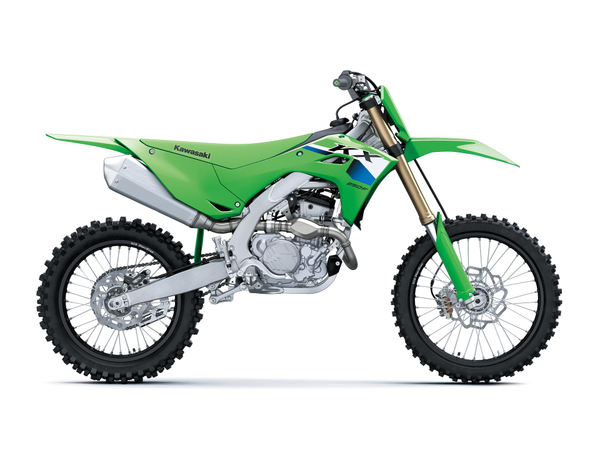
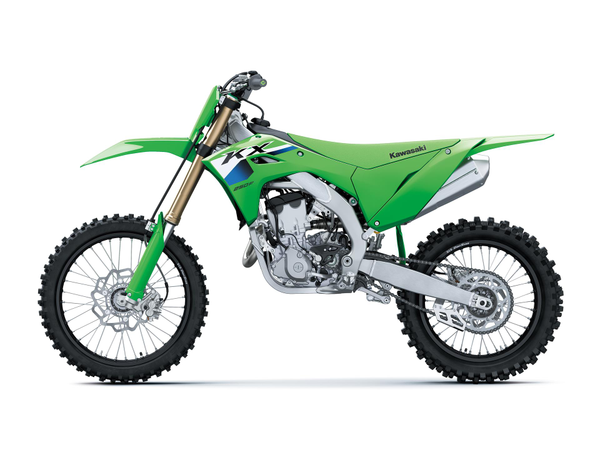
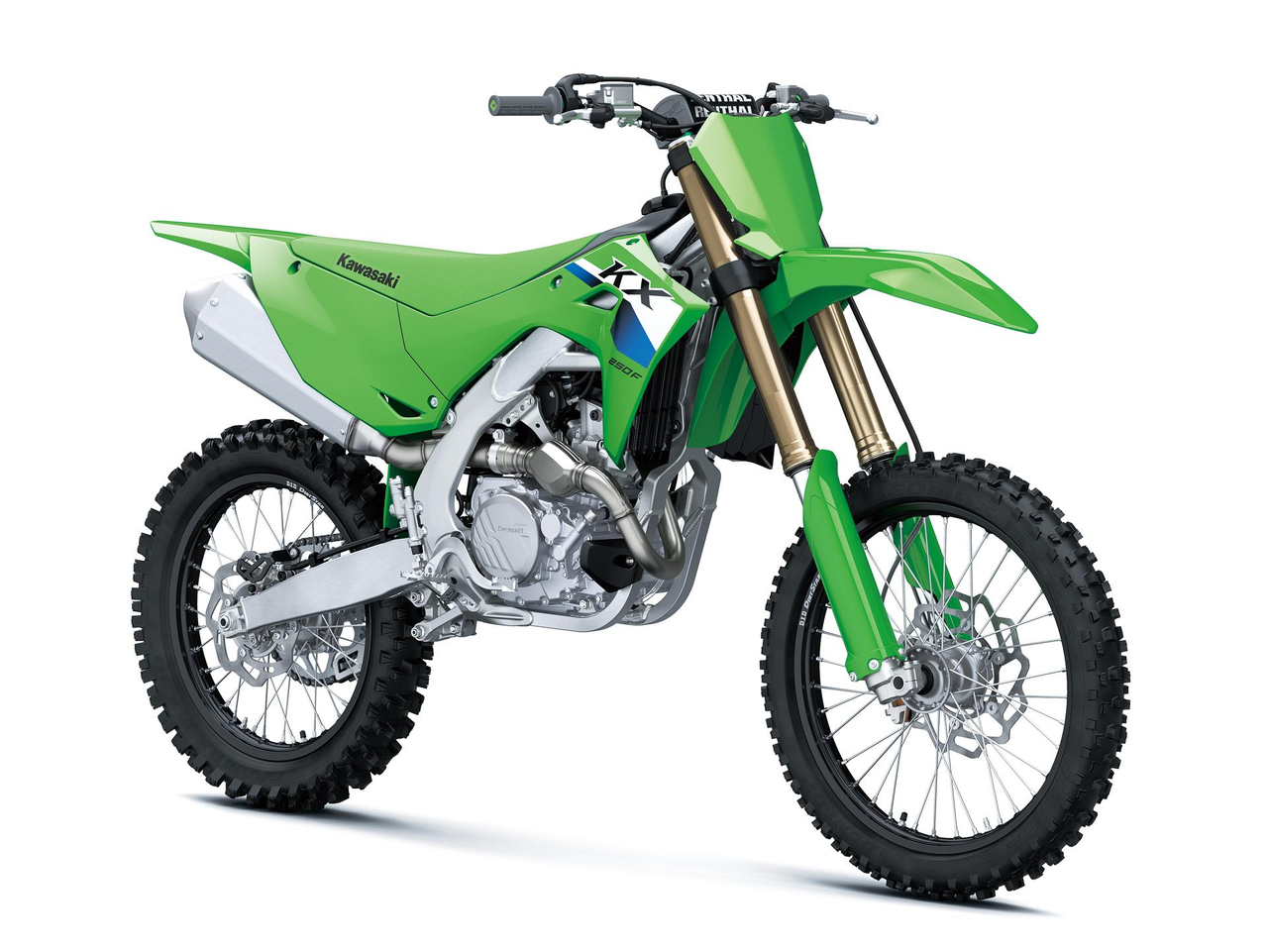
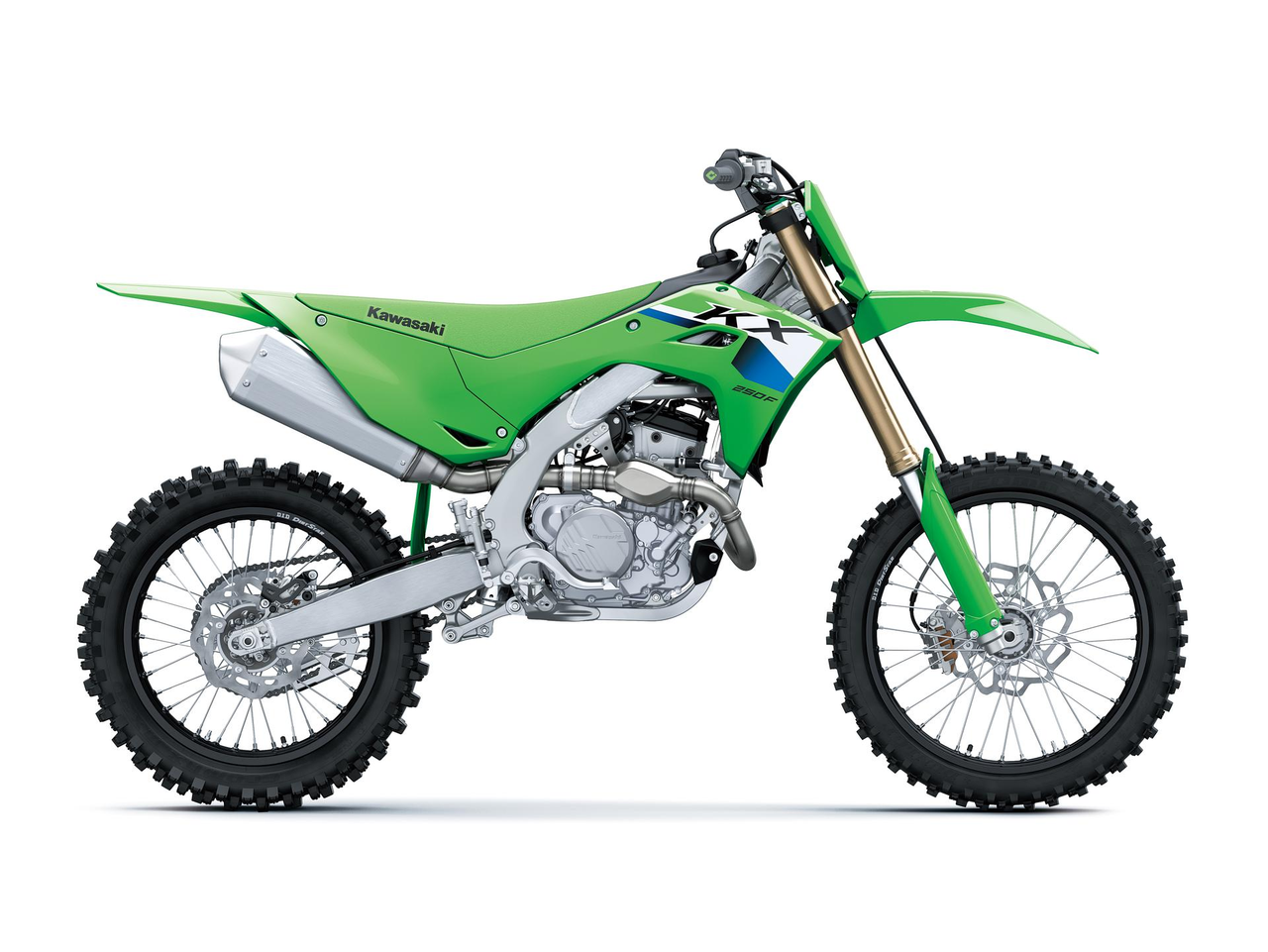
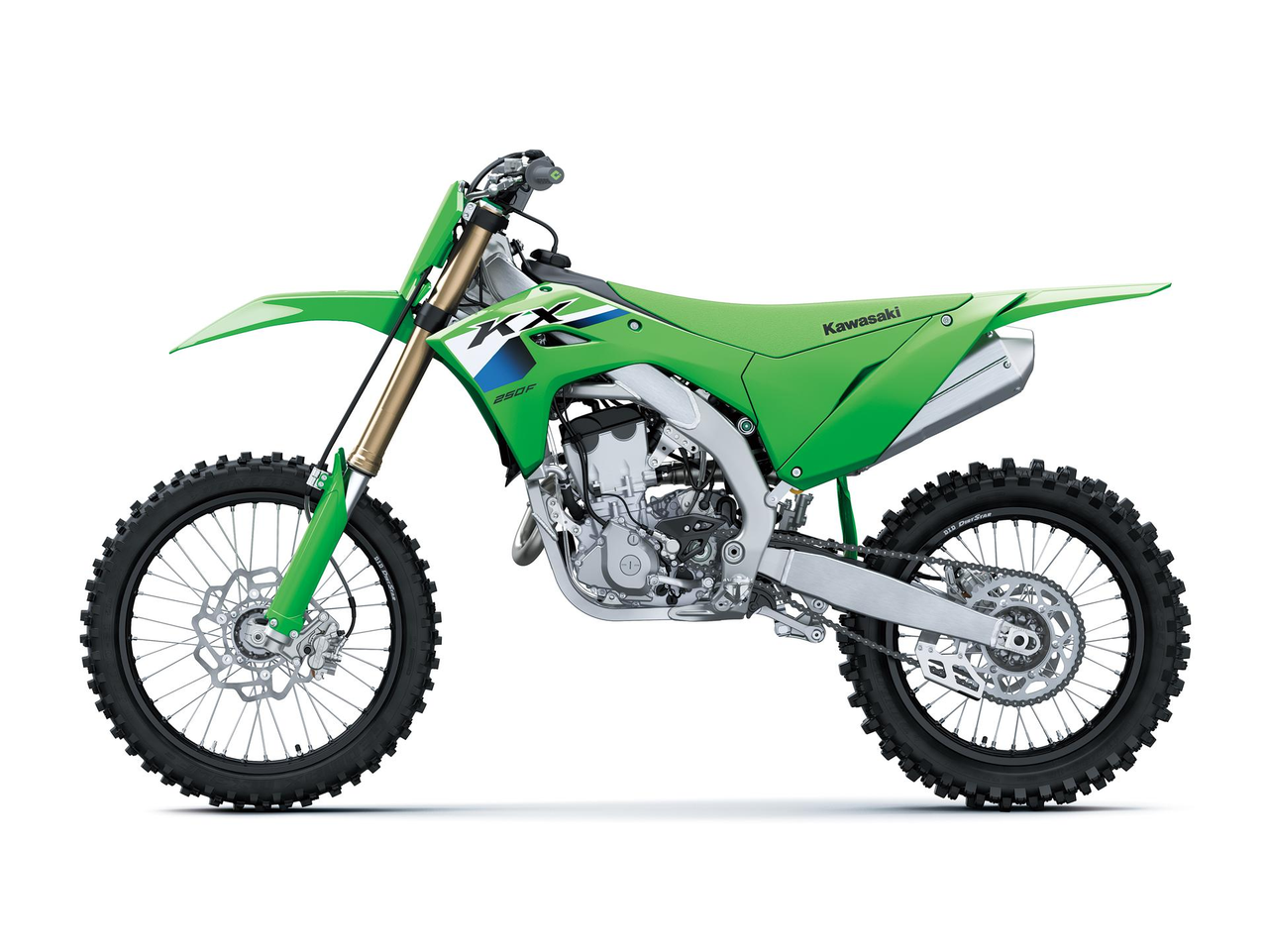
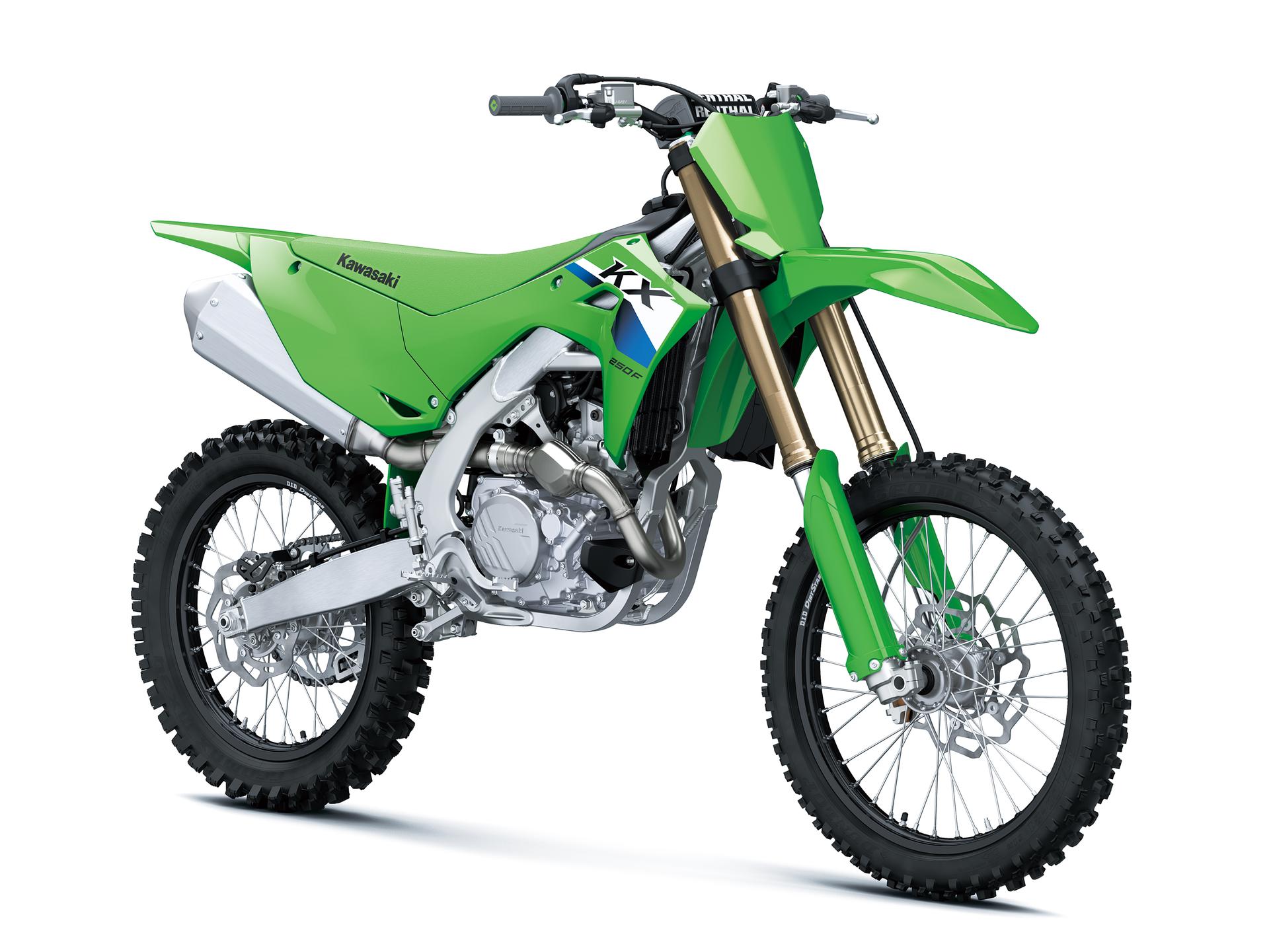
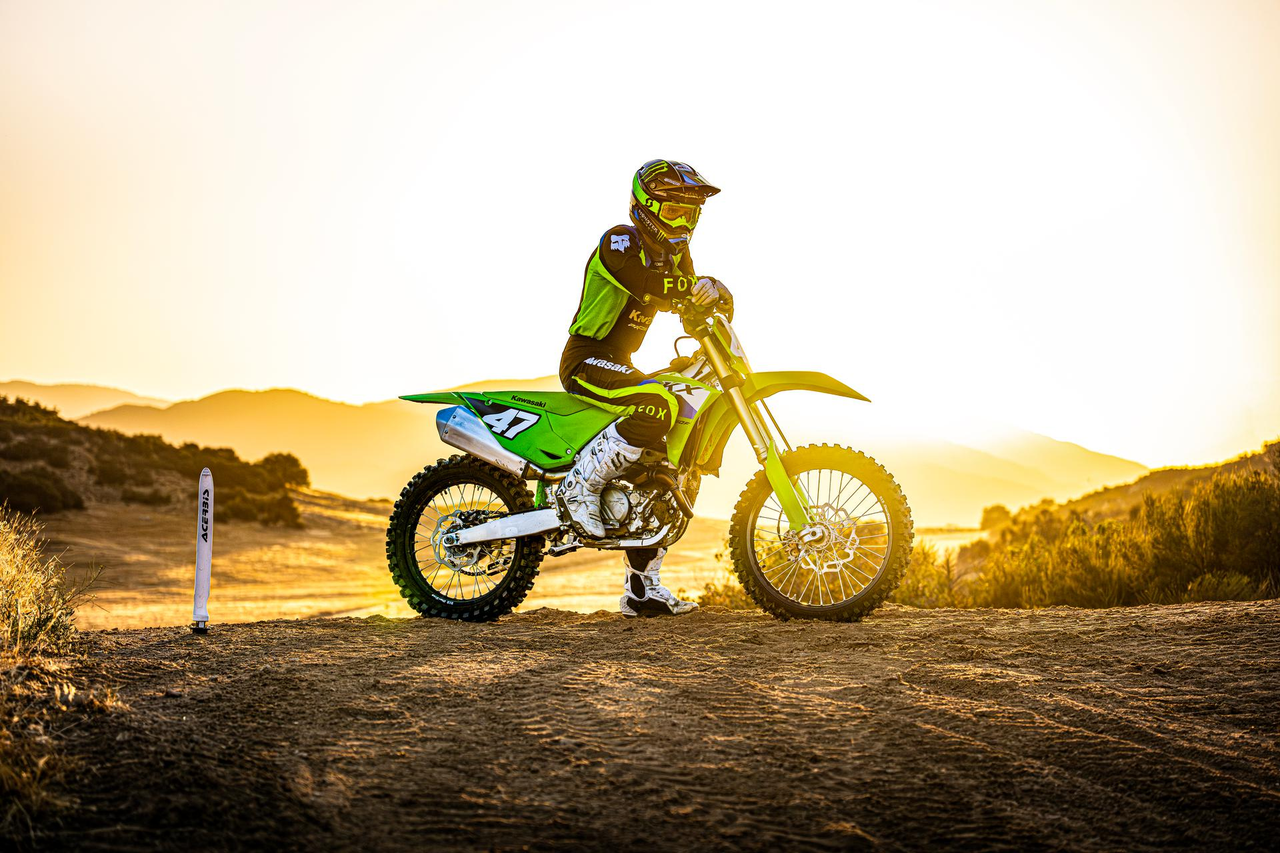
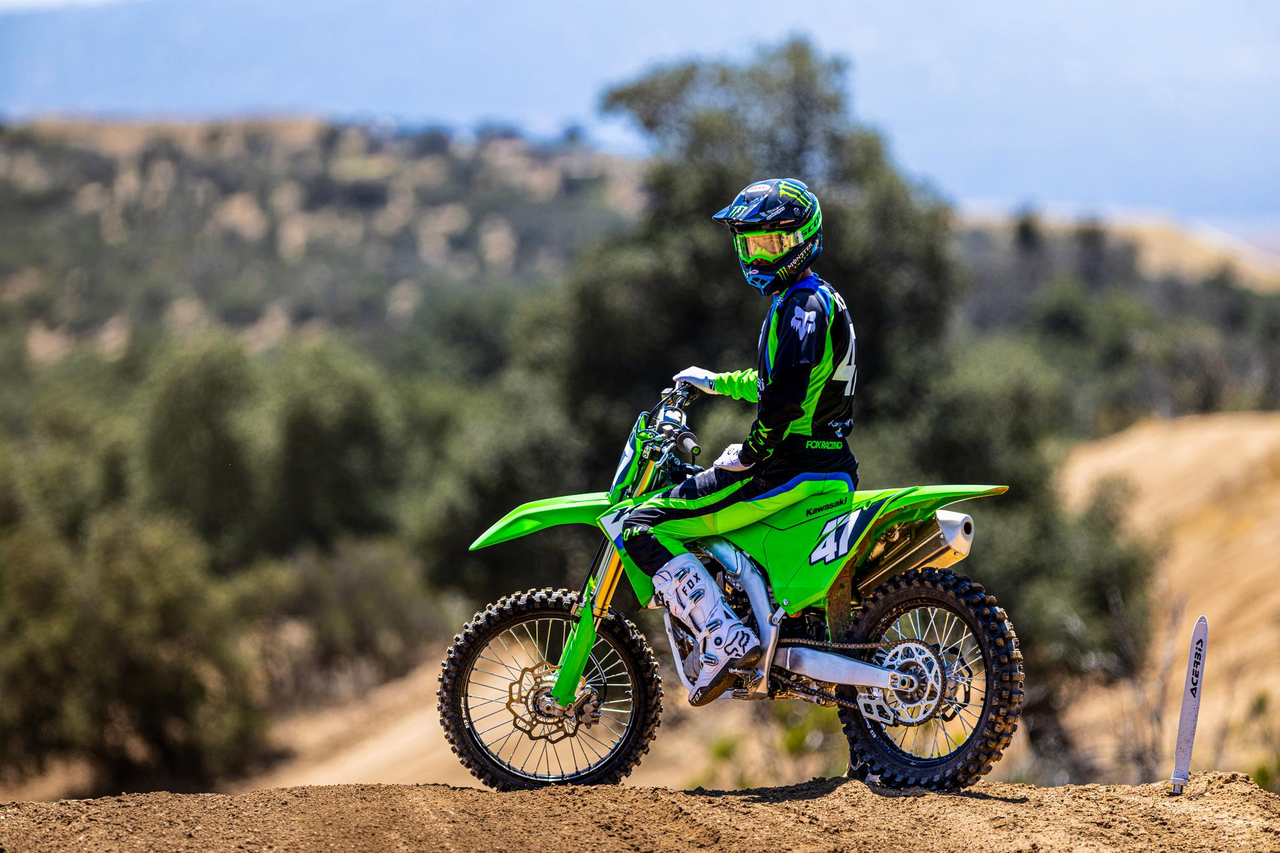
Updated front-end styling, accentuating the KX250F’s sleek, flat design. The compact front number plate features a simple, slim design with minimal surface sculpting to convey a lighter impression. Rerouting the brake hose behind the plate also contributes to a cleaner front-end appearance. The front fender is 30 mm shorter than that of the previous model, with a more steeply slanted forward section that emphasises mass centralisation and overall unity. As before, Aggressive Green colouring—the bodywork and seat are both Lime Green—further highlights Kawasaki’s distinctive racing image and functional beauty.
Using the Mode (M) button on the left handlebar, riders can quickly and easily switch between two engine maps (Normal, Aggressive) provided in the ECU. For the 2027 KX250F, the FI settings in Aggressive mode were revised to deliver a sharper throttle response, offering characteristics that make it easier for riders to extract the strong acceleration they are looking for.
Using the Traction (T) button on the left handlebar, riders can quickly and easily select from two levels (Weak, Strong) of traction control to suit conditions and preference. Riders may also elect to turn the system off.
Factory-style launch control system increases the chance of getting a good start by helping riders maximise traction when starting on a low-traction surface.
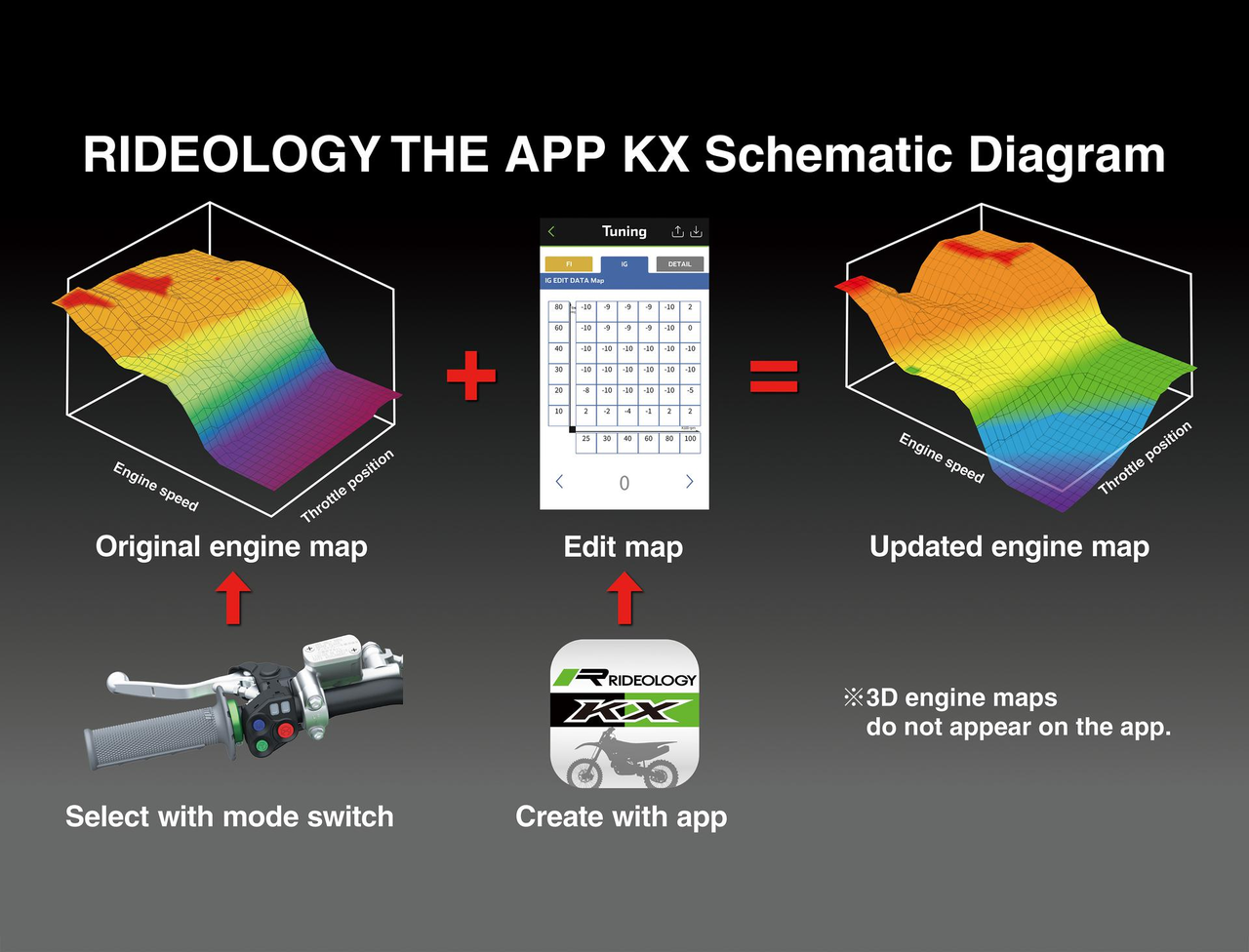
Using the smartphone application “RIDEOLOGY THE APP KX,” riders are able to access and adjust their bike’s engine maps. Functionality (adjusting fuel and ignition timing) is similar to that offered by the accessory KX FI Calibration Kit used with previous models. Maintenance and setup logs are also available. *RIDEOLOGY THE APP KX is not intended for use during vehicle operation. Only use RIDEOLOGY THE APP KX when the vehicle is not being operated and it is safe to do so.


The KX250F engine retains the elements that made it such a strong performer: finger-follower valve actuation, intake and exhaust layout optimised for efficient flow, dual injectors, and a single-shaft primary balancer—elements that together deliver strong, controllable power. Further refinements for 2027 result in increased output, more linear throttle response, and more efficient power transfer, contributing to an overall boost in race-ready performance on the track.
While retaining the previous model’s light, agile handling character, the KX250F motocrosser//KX250FX cross-country racer receives chassis updates that add to its composed behaviour. Central to these updates are revised front and rear suspension settings, which offer increased ground-holding performance, particularly on challenging surfaces. A more compact silencer, used on non-North American models, contributes to reduced weight and mass centralisation, offering chassis characteristics that allow riders to make full use of the improved power feeling.
Power Mode selection, Kawasaki TRaction Control and Launch Control Mode are all accessible from the left handle switches at the push of a button. And with smartphone connectivity, riders can adjust engine maps right from their smartphones.
Even when a machine produces strong power, that power must be delivered in a way that riders can fully control if it is to translate into quick lap times. With this philosophy, the KX250F motocrosser pursues an engine character that is truly “fast” on the track. Revisions to the combustion chamber shape improves combustion efficiency and increases peak power, while an extended exhaust pipe and updated internal structure for the silencer contribute to stronger low-end torque, delivering increased power throughout the rpm range. Updated FI settings add linearity to improve power delivery.
Compared to a conventional clutch, the hydraulic clutch offers more direct feel and lighter lever action. Less play as the clutch heats up during heavy use results in more consistent feeling. Improved for 2027, the clutch spring load has been increased by 15%. This helps suppress clutch slip and allows the engine’s stronger output to be transferred more directly to the rear wheel, giving the rider a more forceful, forward-driving feeling.
Symmetrically aligned intake and exhaust contribute to a strong over-run and smooth low-rpm torque characteristics. The intake offers a straight route for air-fuel mix to enter the cylinder, while the centrally positioned exhaust port lines up with the intake for high airflow efficiency—both contributing to performance. The optimised downdraft intake also adds to low-end performance.
A single-shaft primary engine balancer contributes to smoother power delivery and reduced vibration, which improves control, especially when exiting slower-speed corners.
Being able to restart an engine quickly during a race can mean the difference between keeping your lead or having to fight your way back through the pack. Electric start makes restarting the engine as easy as pushing a button.
The frame delivers both light, nimble handling and a composed character. Its optimised rigidity balance offers the front-end feel that helps riders when cornering, across a wide range of conditions.
A new short-type silencer is featured on the KX250F. The new unit is 50 mm shorter and 230 g lighter, contributing to mass centralisation and a lighter, more responsive handling character.
High-performance Showa Ø 49 mm inverted coil-spring fork and New Uni Trak rear suspension offer race-ready suspension performance and adjustability to let riders tune their settings to suit conditions. Revised suspension settings front and rear offer increased ground-holding performance. The updated settings provide more confident performance on challenging surfaces and make it easier to respond to track conditions that change from lap to lap. Spring rates and damping settings optimised for the cross-country scene offer increased feedback, especially when riding on challenging trails.
Complementing the KX250F’s slim ergonomics, the shrouds, side covers and rear fender feature smooth surfaces that eliminate hooking points, making it easier for the rider to slide back and forth. A choice of four handlebar positions (25 mm forward, 15 mm forward, standard and 10 mm back) and two footpeg positions (standard, 5 mm lower) allows riders to tailor their riding position to suit body size and preference. Factory-style Ø28.6 mm (1-1/8”) Renthal aluminium Fatbar helps reduce vibration and shocks transmitted to the rider.
Medium-compound ODI Lock-On Grips offer excellent grip feel, while their screw-type fastening system greatly facilitates the task of swapping grips.
Left side cover can be removed without tools, facilitating access to the air filter element. The element is now secured with quick-release hooks (previously a wing bolt), which makes changing the air filter a much simpler task—something that enduro or cross-country racers will especially appreciate.
Updated front-end styling, accentuating the KX250F’s sleek, flat design. The compact front number plate features a simple, slim design with minimal surface sculpting to convey a lighter impression. Rerouting the brake hose behind the plate also contributes to a cleaner front-end appearance. The front fender is 30 mm shorter than that of the previous model, with a more steeply slanted forward section that emphasises mass centralisation and overall unity. As before, Aggressive Green colouring—the bodywork and seat are both Lime Green—further highlights Kawasaki’s distinctive racing image and functional beauty.
Using the Mode (M) button on the left handlebar, riders can quickly and easily switch between two engine maps (Normal, Aggressive) provided in the ECU. For the 2027 KX250F, the FI settings in Aggressive mode were revised to deliver a sharper throttle response, offering characteristics that make it easier for riders to extract the strong acceleration they are looking for.
Using the Traction (T) button on the left handlebar, riders can quickly and easily select from two levels (Weak, Strong) of traction control to suit conditions and preference. Riders may also elect to turn the system off.
Factory-style launch control system increases the chance of getting a good start by helping riders maximise traction when starting on a low-traction surface.
Using the smartphone application “RIDEOLOGY THE APP KX,” riders are able to access and adjust their bike’s engine maps. Functionality (adjusting fuel and ignition timing) is similar to that offered by the accessory KX FI Calibration Kit used with previous models. Maintenance and setup logs are also available. *RIDEOLOGY THE APP KX is not intended for use during vehicle operation. Only use RIDEOLOGY THE APP KX when the vehicle is not being operated and it is safe to do so.


2-Mode KTRC (Kawasaki TRaction Control), easily selectable from switches at the left handle.
Using the Traction (T) button on the left handlebar, riders can quickly and easily select from two levels (Weak, Strong) of traction control to suit conditions and preference. Riders may also elect to turn the system off.
Launch Control Mode is a motocross-use start mode that helps riders get the holeshot by minimising wheel spin off the start.
In motocross racing, getting a good start is critical. A few tenths of a second can make the difference between getting the holeshot or not. In slippery conditions, getting the maximum drive from a motocrosser requires precise control of the both the clutch and throttle. Launch Control Mode helps riders get a good start by complementing high-level technique with engine management. Featured on a mass-production motocrosser for the first time on Kawasaki's KX450F, the system activates a separate engine map designed to get a more efficient start off the line. The system is designed to the same specifications as that used by our factory racers competing in the AMA Supercross and Motocross championships. Launch Control Mode is activated simply by pressing the button on the handlebar. The Launch Control map slightly retards ignition timing to help tame the engine's strong torque and reduce wheel spin off the start. Launch Control Mode is only active in the first two gears off the start, disengaging and returning to the standard engine map automatically once the rider shifts into 3rd gear. The system gives riders a great advantage when lining up at the gate and puts them in a better position to win.
Dual Injectors, each with a distinct role, operate at different rpm ranges, to deliver both quick response and increased high-rpm power.
Kawasaki's KX250F was the first mass-production motocrosser to feature Dual Injectors. One injector is located downstream of the throttle valve, where injectors are located on standard FI systems, and a second is located upstream of the throttle valve, close to the airbox. The two injectors split their roles: operating at different rpm ranges, they ensure both smooth, instant response at low-rpm and high peak power at high-rpm. For cases that call for low-rpm operation like instantaneous acceleration off the start and precise control when cornering, primary operation falls to the downstream injector. Because it is positioned close to the combustion chamber, sprayed fuel can be supplied to the engine quickly, resulting in sharp response. Conversely, when high power is the priority, primary operation switches to the upstream injector, which focuses on high-rpm applications. Its location farther away from the combustion chamber means that the fuel has a longer travel time. This allows more time for the fuel particles and air to mix, as well as allowing the mixture to cool and condense. This means that when more power is needed, the cylinder can be filled with a greater quantity of high-quality mixture.
ERGO-FIT is an interface system that allows a wide range of riders to feel at one with their machine.
Proper fit is key for rider comfort and control. However, the ideal fit varies from rider to rider, depending on their physical dimensions and riding style. ERGO-FIT is an interface system designed to allow riders to find their ideal riding position. Various points of the chassis interface (the handlebar, footpegs and seat, etc) can be adjusted through a combination of interchangeable parts and parts with adjustable positions. This enables a wide range of riders to find a riding position that offers both comfort and control. Feeling at one with their machine, they will be able to experience how Kawasaki machines are fun and rewarding to ride. *Adjustable parts and their range of adjustability vary by model.
Smartphone connectivity contributes to an enhanced motorcycling experience by enabling riders to connect to their motorcycle wirelessly.
Clever technology enables riders to connect to their motorcycle wirelessly. Using the smartphone application RIDEOLOGY THE APP a number of instrument functions can be accessed, contributing to an enhanced motorcycling experience. Vehicle information (such as the odometer, fuel gauge, maintenance schedule, etc) can be viewed on the smartphone. Riding logs (varies by model, but may include GPS route, gear position, rpm, and other information) can be viewed on the smartphone. When connected, telephone (call, mail) notices are displayed on the instrument panel. Riders can also make changes to their motorcycle instrument display settings (preferred units, clock and date setting, etc) via the smartphone. And on certain models, it is even possible to check and adjust vehicle settings (such as Rider Mode, electronic rider support features, and payload settings) using the smartphone.
2-Mode KTRC (Kawasaki TRaction Control), easily selectable from switches at the left handle.
Using the Traction (T) button on the left handlebar, riders can quickly and easily select from two levels (Weak, Strong) of traction control to suit conditions and preference. Riders may also elect to turn the system off.
Launch Control Mode is a motocross-use start mode that helps riders get the holeshot by minimising wheel spin off the start.
In motocross racing, getting a good start is critical. A few tenths of a second can make the difference between getting the holeshot or not. In slippery conditions, getting the maximum drive from a motocrosser requires precise control of the both the clutch and throttle. Launch Control Mode helps riders get a good start by complementing high-level technique with engine management. Featured on a mass-production motocrosser for the first time on Kawasaki's KX450F, the system activates a separate engine map designed to get a more efficient start off the line. The system is designed to the same specifications as that used by our factory racers competing in the AMA Supercross and Motocross championships. Launch Control Mode is activated simply by pressing the button on the handlebar. The Launch Control map slightly retards ignition timing to help tame the engine's strong torque and reduce wheel spin off the start. Launch Control Mode is only active in the first two gears off the start, disengaging and returning to the standard engine map automatically once the rider shifts into 3rd gear. The system gives riders a great advantage when lining up at the gate and puts them in a better position to win.
Dual Injectors, each with a distinct role, operate at different rpm ranges, to deliver both quick response and increased high-rpm power.
Kawasaki's KX250F was the first mass-production motocrosser to feature Dual Injectors. One injector is located downstream of the throttle valve, where injectors are located on standard FI systems, and a second is located upstream of the throttle valve, close to the airbox. The two injectors split their roles: operating at different rpm ranges, they ensure both smooth, instant response at low-rpm and high peak power at high-rpm. For cases that call for low-rpm operation like instantaneous acceleration off the start and precise control when cornering, primary operation falls to the downstream injector. Because it is positioned close to the combustion chamber, sprayed fuel can be supplied to the engine quickly, resulting in sharp response. Conversely, when high power is the priority, primary operation switches to the upstream injector, which focuses on high-rpm applications. Its location farther away from the combustion chamber means that the fuel has a longer travel time. This allows more time for the fuel particles and air to mix, as well as allowing the mixture to cool and condense. This means that when more power is needed, the cylinder can be filled with a greater quantity of high-quality mixture.
ERGO-FIT is an interface system that allows a wide range of riders to feel at one with their machine.
Proper fit is key for rider comfort and control. However, the ideal fit varies from rider to rider, depending on their physical dimensions and riding style. ERGO-FIT is an interface system designed to allow riders to find their ideal riding position. Various points of the chassis interface (the handlebar, footpegs and seat, etc) can be adjusted through a combination of interchangeable parts and parts with adjustable positions. This enables a wide range of riders to find a riding position that offers both comfort and control. Feeling at one with their machine, they will be able to experience how Kawasaki machines are fun and rewarding to ride. *Adjustable parts and their range of adjustability vary by model.
Smartphone connectivity contributes to an enhanced motorcycling experience by enabling riders to connect to their motorcycle wirelessly.
Clever technology enables riders to connect to their motorcycle wirelessly. Using the smartphone application RIDEOLOGY THE APP a number of instrument functions can be accessed, contributing to an enhanced motorcycling experience. Vehicle information (such as the odometer, fuel gauge, maintenance schedule, etc) can be viewed on the smartphone. Riding logs (varies by model, but may include GPS route, gear position, rpm, and other information) can be viewed on the smartphone. When connected, telephone (call, mail) notices are displayed on the instrument panel. Riders can also make changes to their motorcycle instrument display settings (preferred units, clock and date setting, etc) via the smartphone. And on certain models, it is even possible to check and adjust vehicle settings (such as Rider Mode, electronic rider support features, and payload settings) using the smartphone.
| Engine Type | Liquid-cooled, 4-stroke, single-cylinder |
|---|---|
| Compression ratio | 14.0:1 |
| Valve system | DOHC, 4 valves |
| Bore x stroke | 78.0 x 52.2 mm |
| Displacement | 249 cm³ |
| Fuel System | Fuel injection: 44 mm x 1 |
| Lubrication | Forced lubrication, semi‑dry sump |
| Starting system | Electric |
| Ignition | Digital DC-CDI |
| Transmission | 5-speed, return shift |
|---|---|
| Clutch | Wet, multi disc |
| Primary reduction ratio | 3.350 (67/20) |
| Gear ratios 1st | 2.077 (27/13) |
| Gear ratios 2nd | 1.688 (27/16) |
| Gear ratios 3rd | 1.438 (23/16) |
| Gear ratios 4th | 1.235 (21/17) |
| Gear ratios 5th | 1.045 (23/22) |
| Final drive | Chain |
| Final reduction ratio | 3.846 (50/13) |
| Frame type | Perimeter, aluminium |
|---|---|
| Rake | 27.0 ° |
| Trail | 118 mm |
| Wheel travel front | 305 mm |
| Wheel travel rear | 307 mm |
| Tyre, front | 80/100-21 51M |
| Tyre, rear | 110/90-19 62M |
| L x W x H | 2,190 x 820 x 1,265 mm |
| Steering angle L/R | 42° / 42° |
| Wheel base | 1,485 mm |
| Ground clearance | 340 mm |
| Fuel capacity | 6.2 litres |
| Seat height | 955 mm |
| Curb mass | 110 kg |
| Front brake type | Single semi-floating petal disc |
|---|---|
| Front brake diameter | Ø 270 mm |
| Front brake caliper type | Dual-piston |
| Rear brake type | Single petal disc |
| Rear brake diameter | Ø 240 mm |
| Rear brake caliper type | Single-piston |
| Front suspension type | Inverted fork with adjustable compression and rebound damping |
| Front suspension diameter | Ø 49 mm |
| Rear suspension type | Uni-Trak, adjustable dual-range (high/low-speed) compression and adjustable rebound damping, and spring preload adjustability |
Inpage Navigation Section: Accessories